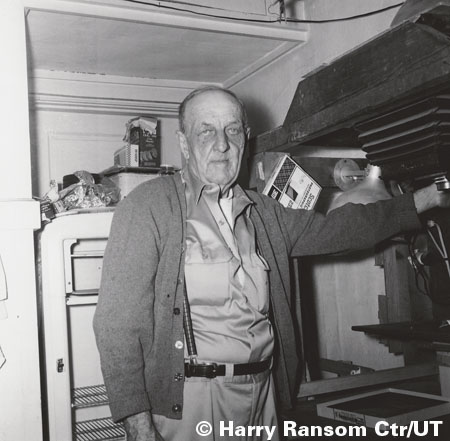
Focus on Reality
W.D. Smithers’ photographs chronicle the state’s Western frontier.
By Dan E. Klepper
Childhood can prove to be a difficult time, wrought with experiences that influence an individual’s path to adulthood. But a life-and-death moment for Texas photographer W.D. Smithers bordered on the supernatural. “A curandera brought me into the world,” Smithers wrote in his autobiography, Chronicles of the Big Bend, “and a curandera saved me, with potions, prayers, and physical nourishment, from typhoid.”
Born in San Luis Potosi, Mexico, in 1895, Smithers spent the first 10 years of his life immersed in Mexican culture while his father worked as bookkeeper for the American Smelting and Refining Company. “Our family curandera, Maria … began each morning of my illness with the gathering of dried and fresh medicinals at the markets. … I was administered donkey’s milk and medicines made from plants that Maria purchased from the vendors, who also sold such things as dried lizards, herbs, small fish, insects, snakes, and the ground bones, horns, and hooves of livestock.”
The curandera’s aid worked, and Smithers slowly recovered. But his trauma didn’t end. His mother, eight-year-old sister Anna and two brothers would all die before Smithers’ 10th birthday.
It was an inauspicious beginning for a boy who would become one of the most important chroniclers of the Texas frontier. In 1905, Smithers’ father moved the remaining family to San Antonio, where Smithers, at a remarkably young age, began his lifelong career in photography. Paid photography apprenticeships weren’t readily available in the early 1900s, so Smithers worked for free at two photography studios. Every afternoon for five years, Smithers would alternate between Archer’s Art Shop and Rayburn’s Studio after working 12-hour shifts delivering blocks of ice from a horse-drawn wagon. This dedication provided Smithers with a hands-on education in photography.
Smithers concentrated on photojournalism until another of life’s events changed everything for him. The death of a familiar face, 114-year-old Juan Vargas, caused Smithers to deepen his focus.
“Thinking of all the things this old man had seen that could never be recaptured, I began to feel that my photography should direct itself to historical and transient subjects — vanishing lifestyles, primitive cultures, old faces, and odd, unconventional professions. Before my camera I wanted huts, vendors, natural majesties, clothing, tools, children, old people, the ways of the border. I was to find all of these things and more in the Big Bend.”
Smithers didn’t have to wait long. The ice delivery job taught him to handle teams and wagons, landing him a position as a mule teamster delivering supplies to troops stationed around San Antonio. Shortly thereafter, Smithers hired on as a teamster for a pack train — a line of mule-driven wagons — delivering supplies to the cavalry stationed along the border with Mexico. Smithers’ first job was a delivery to Eagle Pass, then on to Del Rio, where he and his crew picked up 98 sacks of oats for delivery to the troops stationed in Marfa, a location 275 miles farther west and in the Big Bend.
It took the pack train nine days to arrive at Camp Marfa, where a collection of national guardsmen from Texas, New Mexico and Arizona were stationed. The southern border was considered under assault, and the National Guard units had been sent to the Big Bend to defend it. The year was 1916 — Mexican bandits had raided Glenn Springs in what is now Big Bend National Park, and General Pershing was in pursuit of Pancho Villa after his raid on Columbus, New Mexico. Twelve military outposts had been established throughout the Big Bend, and Smithers began delivering supplies to them, traveling by mule and wagon over the toughest terrain in Texas.
With his camera and journal at his side, Smithers documented the countryside and everything in it, eventually creating an extensive archive of early Big Bend history. The work was exhausting, but Smithers loved it. His images of cavalry life and pack trains against a backdrop of mountains, ocotillos and desert canyons are emblematic of the early 20th century in far West Texas.
Smithers enlisted in the U.S. Cavalry in 1917 and served two years, then returned to driving mule teams. By 1920 he was ready to hang up the reins and devote himself full-time to photography. He opened his own photography studio in San Antonio, a successful venture that allowed him time to travel and explore the Big Bend country he had come to love.
Smithers made frequent trips to the Big Bend and began filing newspaper stories for the San Antonio Light, managing to bridge the 350-mile distance via carrier pigeon in order to submit his timely articles. His longest story, written on an 8.5- by 11-inch sheet of paper, took 10 hours and 15 minutes to arrive by wing at the Light’s San Antonio headquarters from Lajitas. His features, covering an assortment of Big Bend subjects, often appeared with pictures of the pigeons responsible for delivering them.
Smithers designed and built much of his own photography equipment in order for it to survive the Big Bend’s rough and primitive conditions. The success of his San Antonio studio also afforded his purchase of large-format cameras and lenses that helped improve his results.
But by 1929, the lure of the West proved too strong for Smithers, so he closed up shop and moved to the Big Bend for good. The move required him to become just as inventive with his livelihood as he had been with his handmade camera gear. Smithers found work as an aerial photographer for the U.S. Army, took photographs for the U.S. Border Patrol, photographed traveling circuses, acted as a guide for researchers and contracted with the International Boundary and Water Commission to photograph the U.S./Mexican border from Brownsville to San Diego.
Eventually he settled down in the West Texas town of Alpine and opened up shop again. There he produced and sold thousands of postcards and kept up a steady business in lantern slides — glass plates of hand-colored images depicting scenes of West Texas and Mexico. Curiously, Smithers may be best known for the lamps and lampshades made from his photographs. The lampshades featured photos of ranching, landscapes, plants and animals printed on a parchment-like material, then hand-colored and laced onto wire frames.
After more than 30 years in Alpine, Smithers moved west to El Paso, where he continued to work, publishing his autobiography in 1976. He died in Albuquerque in 1981.
Smithers shot more than 9,000 images in his lifetime and, together with his own extensive notes, created one of the most compelling archives of West Texas and the state’s borderlands with Mexico. Stored and catalogued at the Harry Ransom Humanities Research Center in Austin, Smithers’ entire life’s work is accessible for study. Pragmatism, rather than creativity, imbues Smithers’ straightforward style, and this is perhaps what makes the archive more vital than one inspired by artistry.
Smithers showed us what he saw in those fleeting moments of history: an unbiased glimpse into a frontier responsible for creating the rich natural and cultural diversity Texans celebrate today.