Limits and size restrictions are a way of life for those who fish. But there’s one fish that scientists and authorities hope everyone will catch and eat as much as possible: invasive lionfish.
Blame the aquarium trade for introducing the fish, native to the Western Pacific, to U.S. waters, says Keri Kenning of the nonprofit marine education organization Reef Environmental Education Foundation, or REEF.
“It wasn’t Hurricane Andrew, as some have theorized, because lionfish had arrived before then,” she explains, although damage from that 1992 storm likely liberated additional lionfish. “And it wasn’t ship ballast water, which is the source of other invaders. If released ballast water contained lionfish, they would be present all along shipping routes.” That isn’t the case.
“Someone had a few pet lionfish and didn’t want them anymore, probably because they ate all the other fish in the tank,” she says. “So, they released the fish into the South Atlantic.”
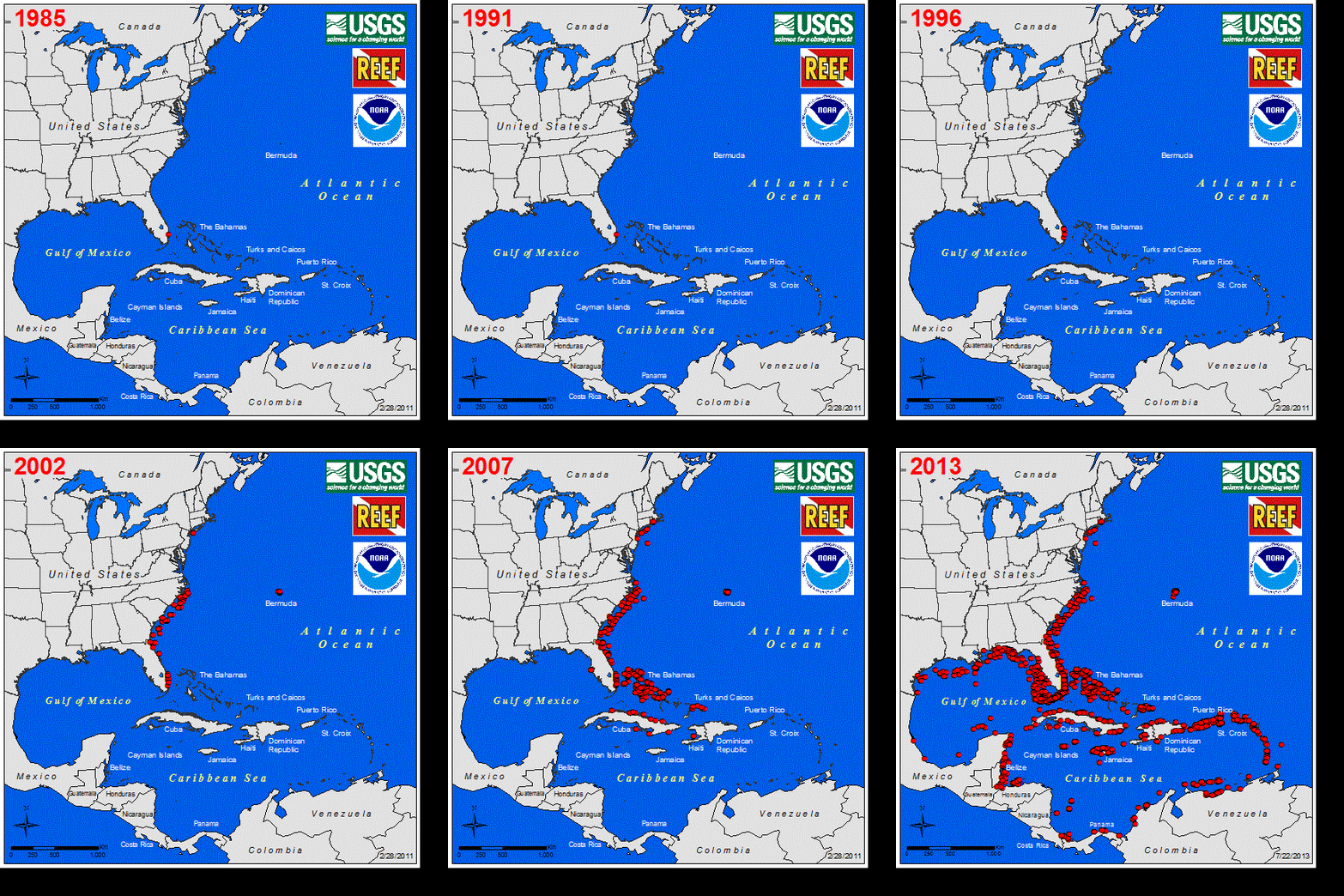
Although other non-native marine species have been introduced via the exotic pet trade, lionfish are the first that took off — and in a big way. Lionfish appeared off South Florida in 1985, then spread by leaps and bounds, moving up the East Coast in the 2000s, covering the Caribbean by 2009 and then moving into the Gulf, reaching Texas in 2011. This spread follows prevailing currents; larvae drift for about 28 days before settling. (See an alarming animation of the spread beginning in 1986 at nas.er.usgs.gov/taxgroup/fish/Lionfishanimation.gif).
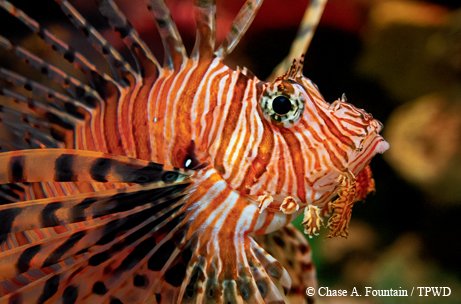
Lionfish protect themselves with their venomous fin rays, sharp points which inject a potent neurotoxin.
Chase A. Fountain | TPWD
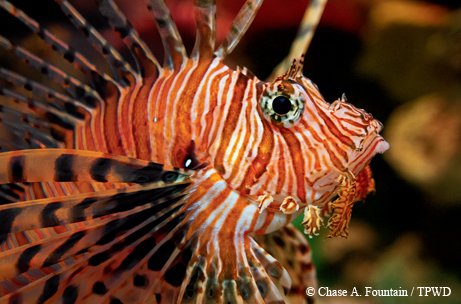
Lionfish protect themselves with their venomous fin rays, sharp points which inject a potent neurotoxin.
Chase A. Fountain | TPWD
The invaders actually include two species, Pterois miles and Pterois volitans, the first normally found along the east coast of Africa and the second throughout Oceania, with an overlap around Indonesia. But to the average observer, the two are indistinguishable.
In their native range, about 80 lionfish occupy one kilometer of reef. In the Bahamas in 2008 and 2009, researchers counted nearly 400 per kilometer, and Kenning notes there has been a significant increase since then. To lionfish, the Atlantic Ocean, Gulf of Mexico and Caribbean Sea must seem like paradise indeed: no predators, no competition and plenty to eat. As a result, the fish are a terrifying model of success.
Secrets of Lionfish Success
“In every habitat where we’ve looked for lionfish, we’ve found them: seagrass beds, mangroves, wrecks and artificial reefs, natural reefs, even three miles up a river,” Kenning says. “They have a wide tolerance for temperature, salinity and depth. We’ve found them from one inch deep to 2,000 feet, from Massachusetts to South America.”
Adding insult to injury, lionfish reproduce early (within one year) and often, capable of spawning every four days year-round. While many reef fish are broadcast spawners, lionfish spawn in pairs, and the female releases two buoyant egg masses containing from a few thousand to 15,000 eggs. That means one female can pump out 2 million eggs a year.
In the future, we’ll offer removal permits to experienced divers who have attended a workshop, and ask that they bring the fish back for us to research.
Michelle Johnston, Research Ecologist
In their native Indo-Pacific, there are 13 different species of lionfish and much greater biodiversity overall, much more potential competition. Parasites and predators eating eggs and larvae keep lionfish numbers in check. Back home, they also face parasites and diseases that don’t seem to have traveled with them. Consider that the original invaders survived being harvested, shipped in a freighter, held in a customs warehouse, kept in an aquarium and then dumped into a strange habitat. Any lionfish that made it through all that clearly had great genes.
Once on our reefs, the lionfish found native fish (which have no idea what a lionfish is) to be easy pickings. More than 70 different prey species have been found in lionfish stomachs, and those stomachs can expand up to 30 times normal size. Anything that fits in their mouths is fair game.
The voracious invaders eat many commercially important species, such as snapper, grouper and grunt. They also eat what those species eat, leaving natives with less food. Lionfish eat recreationally and ecologically important species, from all the pretty things divers like to see to the fish that keep reefs clean.
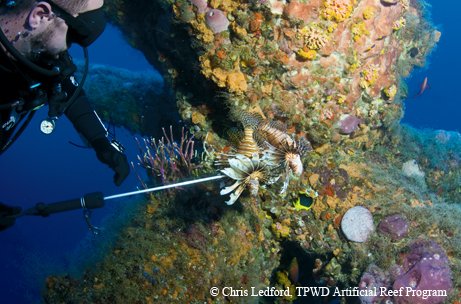
TPWD employee Bryan Legare shoots lionfish at an artificial reef site in the Gulf of Mexico.
Chris Ledford | TPWD Artificial Reef Program
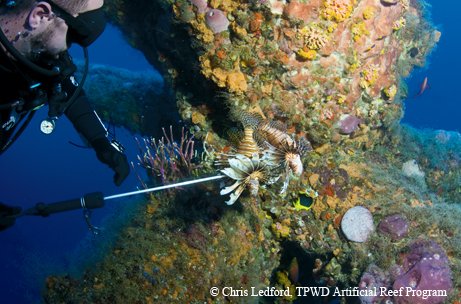
TPWD employee Bryan Legare shoots lionfish at an artificial reef site in the Gulf of Mexico.
Chris Ledford | TPWD Artificial Reef Program
Staff at the Flower Garden Banks National Marine Sanctuary have seen lionfish hanging out at a cleaning station on Stetson Bank, picking off the little cleaner fish. That, one staffer says, is “completely against the rules of the reef.”
In the Bahamas, Kenning says, lionfish reduced the native fish prey community by 65 percent in just two years. Some sites experienced a 95 percent decline. An Oregon State University study showed that lionfish have reduced native fish populations by up to 80 percent in the Atlantic.
The lionfish invasion is a huge concern.
Emma Hickerson, Flower Garden Research Coordinator
Thanks to this kind of clearly unsustainable gluttony, the largest lionfish collected off the U.S. coast was more than 18 inches long, while the maximum size in their native range is about 13 inches. Tagging studies have shown that a lionfish can grow up to nine inches in a year.
Meanwhile, nothing seems to be eating them. Occasionally, sharks, groupers or eels have been seen snacking on lionfish, but in general, native predators recognize lionfish as dangerous. A study published by researchers at the University of North Carolina in July 2013 concluded that native predators will be unable to control invasive lionfish. The key, scientists say, is human removal.
Ready to fire up the grill?
Control methods
It’s legal to remove lionfish from all Texas waters, with a spear, net or hook and line.
“Contrary to what you might believe and many photos, though, they generally aren’t out on top of reef and easy to see,” warns Kenning. Look for them in caves, crevices and dark spots. The greatest relief or largest structure on a reef is where the most lionfish will be. (See sidebar on safe handling.)
Lionfish derbies are proving good at short-term control, capturing as many as 2,000 lionfish in one day. At Green Turtle Cay in the Bahamas, REEF conducted a survey of 80 different sites both within and outside a derby hunting area one week before the event, then recounted the same sites a day after the derby. According to that work, the 771 fish removed by derby participants equaled 69 percent of the population. A Palm Beach, Fla., derby brought in 1,043 fish, which REEF calculated would have eaten up to 8.8 million prey fish in the next year. So derbies are effective, but the key is holding them regularly.
Welcome to Texas
Eight lionfish were seen near the Flower Garden Banks sanctuary, 100 miles off the Texas coast, in 2010, and 28 within its boundaries in 2011. In 2012, 237 were observed in and around the sanctuary. Their average size there has increased from 6 inches in 2012 to 12 inches in 2013.
“The lionfish invasion is a huge concern,” says Flower Garden research coordinator Emma Hickerson.
Their outsized predation could shift the Flower Garden’s coral-dominated habitat to an algal-dominated one.
Although spearfishing is not allowed in the sanctuary, all divers on staff have permits to remove lionfish, as do dive operators on the Fling dive charter boat. Management is also considering special allowances to hold a derby there.
“You have to be careful about what the spear hits behind the fish,” says sanctuary research ecologist Michelle Johnston. “Nets won’t do as much damage.”
Another concern is that if someone gets poked by a lionfish spine, which can deliver venom, the victim is a long way from shore, and it might mean cutting a trip short.
“In the future, we’ll offer removal permits to experienced divers who have attended a workshop,” she says, “and ask that they bring the fish back for us to research.”
Meanwhile, anglers can take all the lionfish they want from the sanctuary with hook and line, although catches of lionfish via this method in shallow waters are rare since these predators stalk and eat live prey whole. Some have enjoyed success using cut squid as bait.
At this time, staff don’t recommend eating lionfish caught in the sanctuary, currently a hot spot for ciguatera, a food poisoning found in predatory fish, lionfish included. To date, though, no cases from lionfish have been reported, and the toxin is localized to particular places and times. Anglers just need to be informed.
So, ladies and gentlemen, take up your forks and knives. Participate in a derby, eat a lionfish, and ask restaurants to serve it. The natives of the Gulf of Mexico are counting on you.
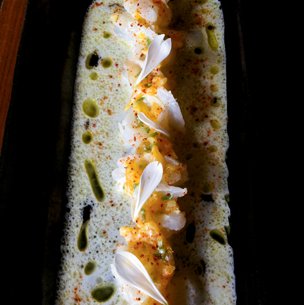
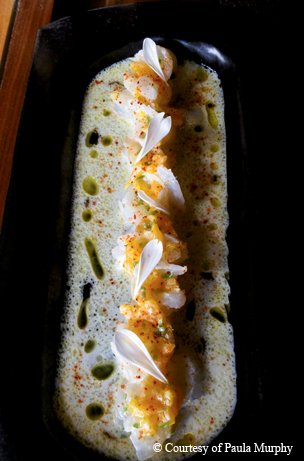
A lionfish dish called poisson cru, made with raw lionfish and coconut milk, from Houston’s Haven Restaurant.
A lionfish dish called poisson cru, made with raw lionfish and coconut milk, from Houston’s Haven Restaurant.