Between the historical bookends we know today as the Republic of Texas and the Civil War lies the dog-eared and faded novella of early statehood, the Antebellum Era of Texas.
Although typically measured by the rise of abolition and polarization of the country, the mid-1800s were also a time of invention and innovation — a new spirit was stirring. While the eastern U.S. navigated a second wave of industrial revolution, the western lands remained wild and unfenced.
But “there’s gold in them thar hills,” as the saying goes. Westward expansion was imminent, and in Texas, just 10 short years after becoming a state in 1845, the Army was building a series of forts to protect settlers traveling an undomesticated and unpaved stretch of hostile desert land. It was a difficult journey for any horse, mule or man, especially those laden with supplies. It was no different for the U.S. Army.
Enter the camel — an animal known for its desert prowess, strength and longevity, as well as its ability to travel for days without water in sweltering heat. The camel seemed perfectly evolved for the American West. Jefferson Davis, then U.S. secretary of war, agreed.
So, in February 1856, with the help of the U.S. Navy, Maj. Henry Wayne and his crew left the shores of Smyrna, Turkey, with a cargo of 33 camels for the long trek across the Atlantic back to Indianola. The 87-day trip through stormy waters was the beginning of an experiment that we now know as the U.S. Army Camel Corps.
Post-arrival, the camels were stabled at Camp Verde, north of Bandera, then eventually dispatched westward through the Big Bend region, across the territories of southern New Mexico and Arizona, and later to Fort Tejon, California.
Although the camel’s use as a military animal goes way back, the U.S. Army quickly settled on using the ungulates for transport and not warfare. It was a quartermaster’s dream. Camels were not only easier to feed and water, but they also outperformed the typical mule in load capacity, and could carry loads over longer distances. Within eight short months, Maj. Wayne was convinced: “The usefulness of the camel in the interior of the country is no longer a question here in Texas,” he recorded in his subsequent report to Davis.
But alas, they did not see the future coming. While Wayne predicted it would take 10 years to establish the camels and prove their value, only three and a half short years later, the Civil War consumed both the country’s funds and interests. By the end of the war, expansion of the railroad eliminated the need for camels entirely, and their heyday in Texas came to an end.
Today, only faded images of the great camel experiment remain — a smattering of documents and photos spread across the historic forts and outposts of the West. But one native Texan is working to keep their memory alive.
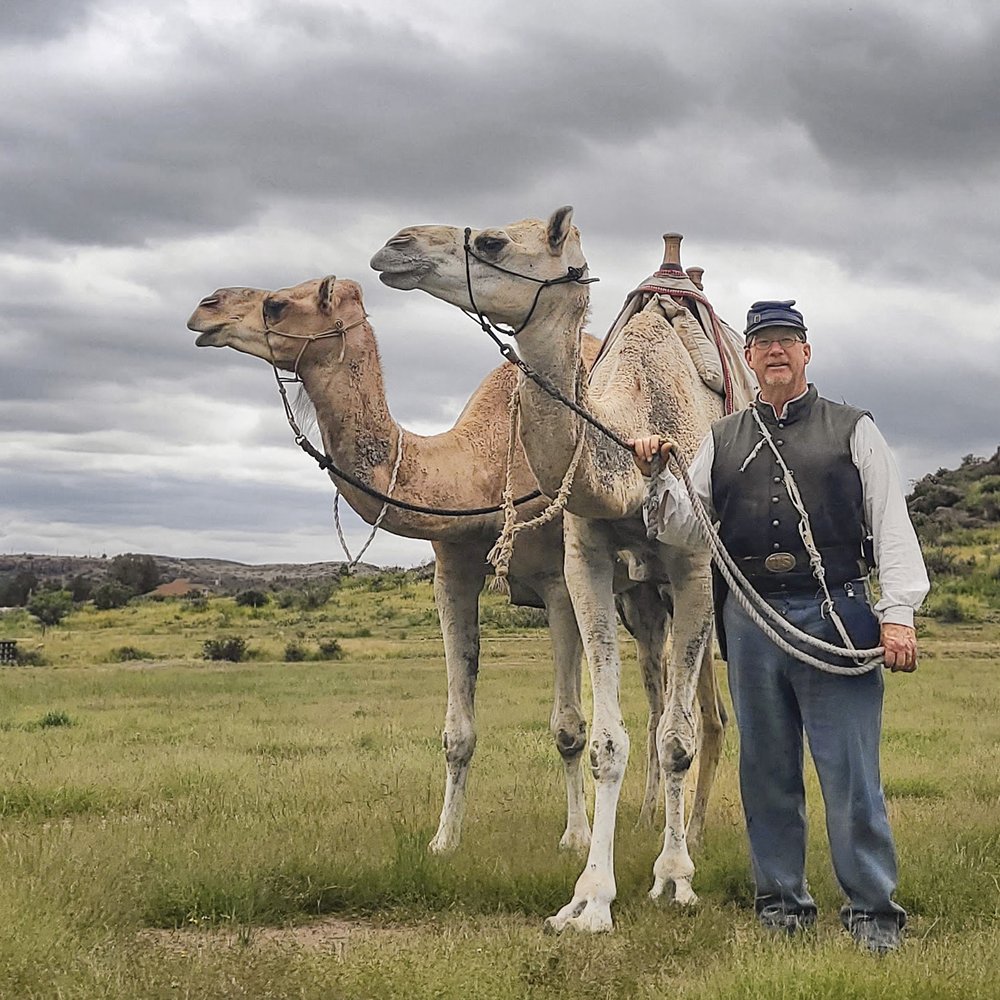
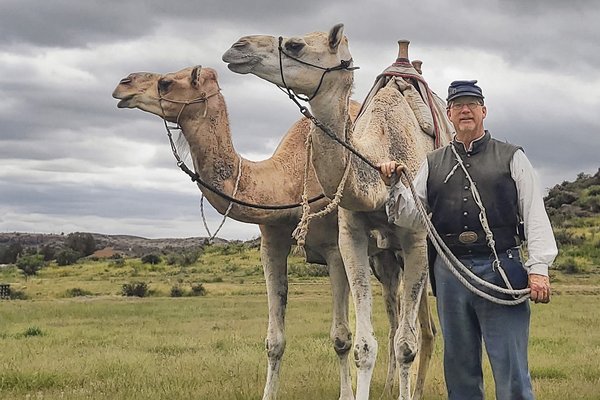
Meet Doug Baum. Baum and his camels, 10-year-old Daleel and 13-year-old Jadid, are easy to spot across the grassy parade ground of historic Fort Davis. Baum is dressed in traditional 1850s uniform, Daleel in the style of north Arabian camel saddles, and Jadid stands unadorned. All of them, however, are draped in the wide-eyed wonder of both children and adults alike. Baum answers questions with unending patience, while the camels carry on their chewing and regurgitating unfazed, clearly used to the attention. When the crowds quiet, Baum and I take both animals for a stroll.
“I suspect it might have been a bit of a stopgap for Jefferson, a way to bridge time between the existing eastern railroad and its eventual westward advancement,” Baum replies to my question on why the experiment commenced and ended when it did. “It wasn’t a failure; camels were brought here to carry things, and carry things they did. There are stories about the soldiers not liking or accepting the camels, but soldiers are there to do a job and they’ll do that job regardless.”
We pause near some overgrown brush for a quick snack. “Oak and hackberry are their favorites,” he says with warmth, one hand on Jadid’s girth. Pride is not the right word to describe the energy I sense in Baum; there is no ego here. There is only affection and respect for these animals, for the impact they’ve had on his life, for the patience they’ve taught him.
In Arab countries, camels always were, and still are today, more than a means to an end. In such a harsh desert environment, they are survival, and much like the western horse to the cowboy, the dog to its owner, the camel is family.
As the day ends and the overtones of a bugle echo across the grounds, Baum invites me to help lead the camels to the trailer. Both are eager to move, and once inside they quickly spin around, positioning themselves for the ride home. At Baum’s encouraging I step in to unclip lead ropes, and for a moment, standing between these two scraggy beasts that tower over me, I’m aware of a certain closeness, a quiet intimacy paired with raw vulnerability, a connection to something larger than myself.
Camel. Camello. Kamel. Gamal. Ship of the Desert. Whatever you call it, in the camel we find a sense of stability, of faith and trust, and in the Camel Corps experiment an inherent reminder to think creatively and to pace ourselves in this ever-changing world. After all, life really is a journey, not a race.
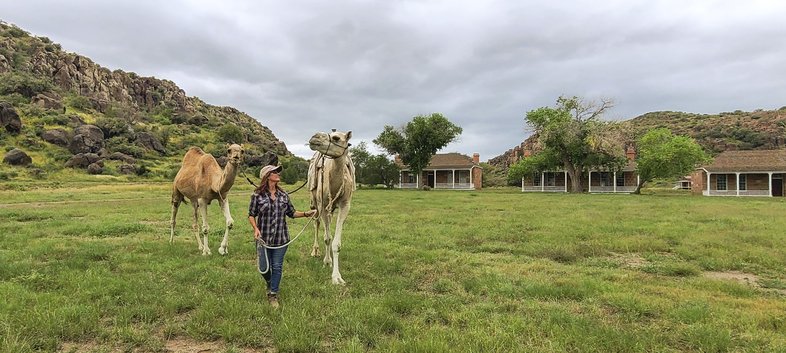
Camels were used at a historical event at Fort Davis National Historic Site.
Shannon King
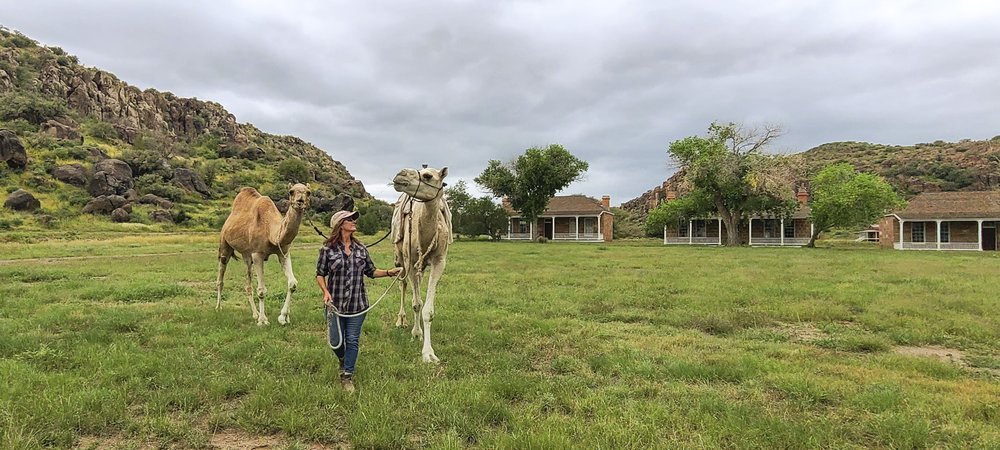
Camels were used at a historical event at Fort Davis National Historic Site.
Shannon King