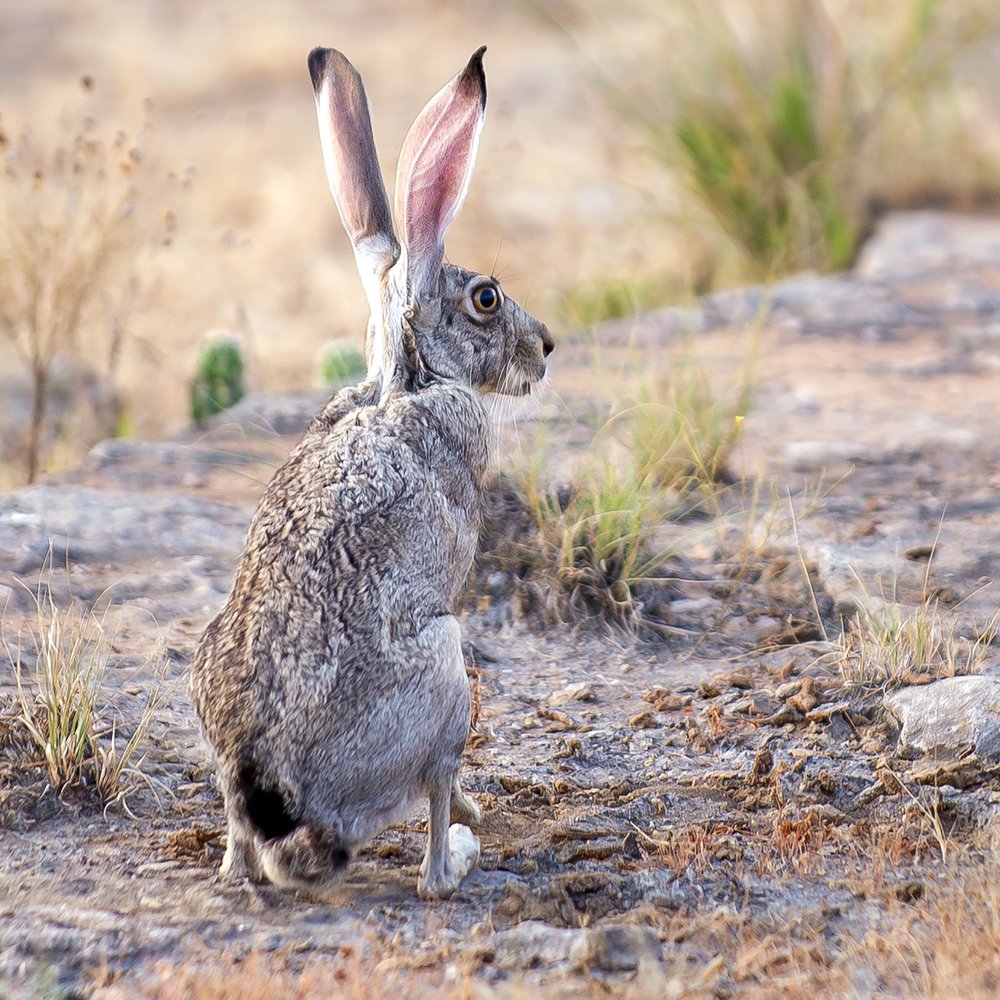
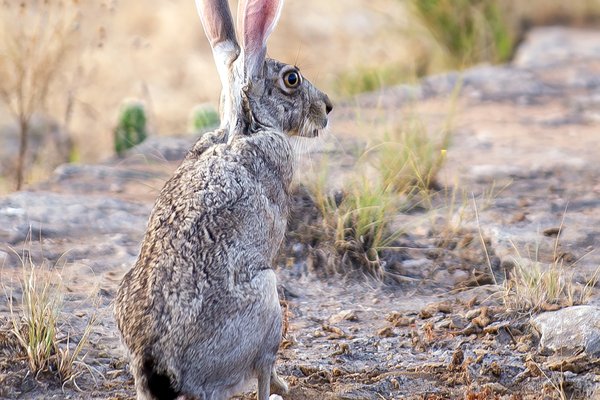
Imagine it’s early morning and you step outside a bunkhouse in Big Bend Ranch State Park. As the first rays of sunlight illuminate the scruffy grass and brush, you spy a few black-tailed jackrabbits. While their buff-colored fur blends into the landscape, a pair of impressive ears gives them away.
Those ears can stand 7 inches tall, about the same length as the hind feet that give these critters the power to run up to 40 mph and jump up to 20 feet. They use those abilities to escape predators like hawks and coyotes. Most active at dusk and night, when they can forage more safely (and avoid daytime heat), jackrabbits feed on grasses, shrubs and even cacti in summer and woody and dried vegetation in winter. A long digestive tract breaks down the tough fibers in this diet.
While their name is a portmanteau of “jackass” for their donkey-like long ears and “rabbit,” jackrabbits are actually hares. Hares are born with fur and open eyes, nest in small ground depressions, and, as noted, prefer to run rather than hide. Rabbits are born furless with closed eyes, live in burrows and generally hide from predators, running only as a last resort.
Both rabbits and hares are in the mammalian order Lagomorpha, species known for breeding like, well, rabbits. Black-tailed jackrabbits are no exception, producing one to four litters a year of up to eight young, known as leverets. Lagomorphs are mostly absentee parents, with mothers nursing their young only once a day. But they produce some of the richest milk of all mammals, and their young grow rapidly. Jackrabbits can fend for themselves one month after birth.
Besides making jackrabbits hard to sneak up on, those long ears dissipate heat through a network of blood vessels. Dense fur helps to keep the animals cool on hot days by reflecting sunlight and reducing heat absorption and warms them on cold nights by trapping an insulating layer of air close to their body.
Black-tailed jackrabbits are an important link in the food chain as prey for carnivorous birds, mammals and snakes.
“They are eaten by lots of things, moving nutrients and energy through the food web,” says Kerry Griffis-Kyle, professor in the Texas Tech University Department of Natural Resources Management.
Their selective grazing can stimulate plant growth, their digging behavior aerates the soil, and their droppings provide fertilizer. The hares also disperse seeds through their droppings and on their fur.
Jackrabbit numbers can boom and bust due to factors like drought or disease, says Griffis-Kyle. During a recent drought, for example, hordes of the hares decimated a Lubbock golf course. “It had been a really dry year, and they were going after plant roots to get moisture.”
In addition to Big Bend Ranch State Park and the fairways of Lubbock, look for jackrabbits around the Barton Warnock Visitor Center, Caprock Canyons State Park, Davis Mountains State Park, and many other parks in central or western Texas.