During the work week, Mike Farley is a machinist in Central Texas, where he’s worked for the same mom and pop machine shop for more than 30 years. Once he clocks out, Farley does something completely different: he’s an avid citizen scientist, and the state’s taxonomic expert on swamp rabbits.
Farley became a Texas Master Naturalist in 2014, and through the organization he learned to set up cameras to observe wildlife. In Williamson County, where he lives, Farley was excited to observe an elusive, nocturnal, wetland-dwelling creature that few have seen. “I fell in love with swamp rabbits, and so I still obsessively observe them and watch what they're doing,” he says.
Farley is one of the tens of thousands of citizen science volunteers across the state who contribute to community science efforts through organizations such as the Texas Nature Trackers and the Texas Master Naturalists. Through his camera trapping work, and documenting species through iNaturalist, Farley has provided important data to the Texas Parks and Wildlife Department’s research projects.
The term “citizen science” was first used in a 1989 issue of MIT Technology Review, in an article that highlighted community-based labs studying environmental issues. Since 1989, the field has taken off, fundamentally changing the scope of data collection that is possible for researchers.
Citizen science is most beneficial for projects in which there is an immense amount of data that volunteers can help collect or analyze. Thanks to apps such as iNaturalist and volunteer research platforms such as Zooniverse, citizen scientists have contributed to fields from astronomy to ecology.
In 1992, shortly after the term “citizen science” was coined, the Texas Parks and Wildlife Department started its own program to engage the community in research projects: the Texas Nature Trackers. The Nature Trackers document the status of wild plants and animals across Texas. From frogs and toads to bats and whooping cranes, their work helps define the ranges of our native species and send the alert when a species is in trouble.
When Michelle Haggerty, the coordinator of the Texas Master Naturalist program and leader of the Texas Nature Trackers citizen science team, started at the agency in 1999, the team was running frog and toad surveys. “Everything was on paper at that time, where the team had developed a survey route and protocol and then a data sheet,” she says. “They were mailing packets to volunteers and running survey seasons, and volunteers were mailing packets and data sheets back.”
Apps such as iNaturalist, which the Texas Nature Trackers team adopted around 2014, changed the game for the citizen science team. “The evolution today — we have come light years from data sheets,” says Haggerty. “We’ve moved from data sheets to online databases, and now we’re entirely using iNaturalist and Survey123, all from your smartphone.”
iNaturalist specifically is now a key part of the program. “It’s helping us to document species, document change, and it’s providing a connection for people and natural resources in public spaces,” says Haggerty. “And the information it’s helping us to find — it’s something that we could not do on our own. That alone is probably its most valuable asset. We would not have a program today without it.”
Right now, the Texas Nature Trackers team runs more than a dozen projects, from broad species surveys to more targeted projects focused on species of greatest conservation need. They’re also conducting Bioblitzes on many different state properties, including newly acquired parkland.
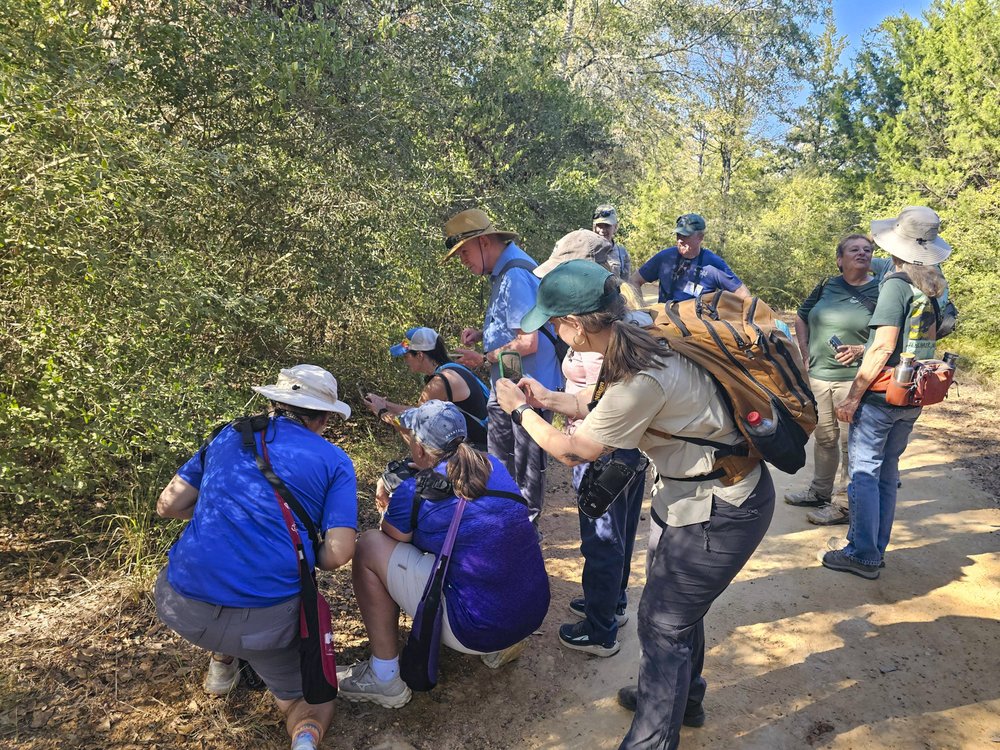
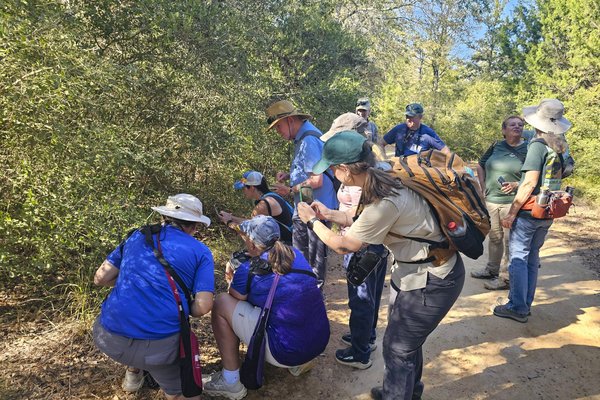
“We invite teams of volunteers — and that may include students from universities pursuing natural resource degrees, professors from different labs — and we bring people out to the property locations, get them in the field, and just have a weekend-long, three-day-long blitz of looking for and documenting whatever they can find on a certain property,” says Haggerty.
Another Texas Nature Trackers project, the Great Texas Bats and Bridges Project, is a collaboration with the Texas Department of Transportation, in which volunteers aim to survey all the bridges in Texas to look for bat colonies. “That will help TxDOT with traffic planning, maybe building better bridges, better habitat,” says Haggerty. “If they find bridges that are beneficial for bats, they’ll continue with that model of bridge.”
To Haggerty and Texas Nature Trackers biologist Wendy Anderson, citizen science goes beyond contributing data — it also helps people feel more connected to the natural world. “It helps train these naturalists to see what is in the world around them,” says Anderson. “By learning what they’re seeing in the world around them, they get a greater appreciation, and want to do more and more and more. They want to explore, what are the birds in their area? And then it segues to, what are the flowers in their area? What are the moths in their area? And soon they become experts in their own right, just because of their own curiosity.
Find Your Project
Texas Nature Trackers
The Texas Nature Trackers has a project for everyone. Participate in a City Nature Challenge, help out with a Bioblitz, or dive deeper and try out a project like the Bat Acoustic Monitoring Project, which requires special training from the Nature Trackers team. Or, just log into iNaturalist and submit your observations to one of the projects. tpwd.texas.gov/huntwild/wild/wildlife_diversity/texas_nature_trackers/projects
NASA
NASA’s citizen science projects range from classifying images of galaxies in a project called “Galaxy Zoo,” to observing lake levels. Many are kid-friendly — great for homeschool science projects! science.nasa.gov/citizen-science
Harte Research Institute
Take a walk on the beach for science! The Harte Research Institute’s Nurdle Patrol program needs citizen scientists to help monitor small plastic pellets that wash up on the beach. www.harteresearch.org/project/nurdle-patrol-citizen-science-program
SETI@home
Check out Berkeley’s SETI Research Center (SETI stands for the Search for Extraterrestrial Intelligence) to analyze radio signals for signs of communication from beyond. setiathome.berkeley.edu
Zooniverse
Register as a volunteer on this online platform to help out with more than 150 projects. From helping digitalize a museum’s snail collection to counting fish in New Zealand, Zooniverse offers projects for every interest and skill level. www.zooniverse.org