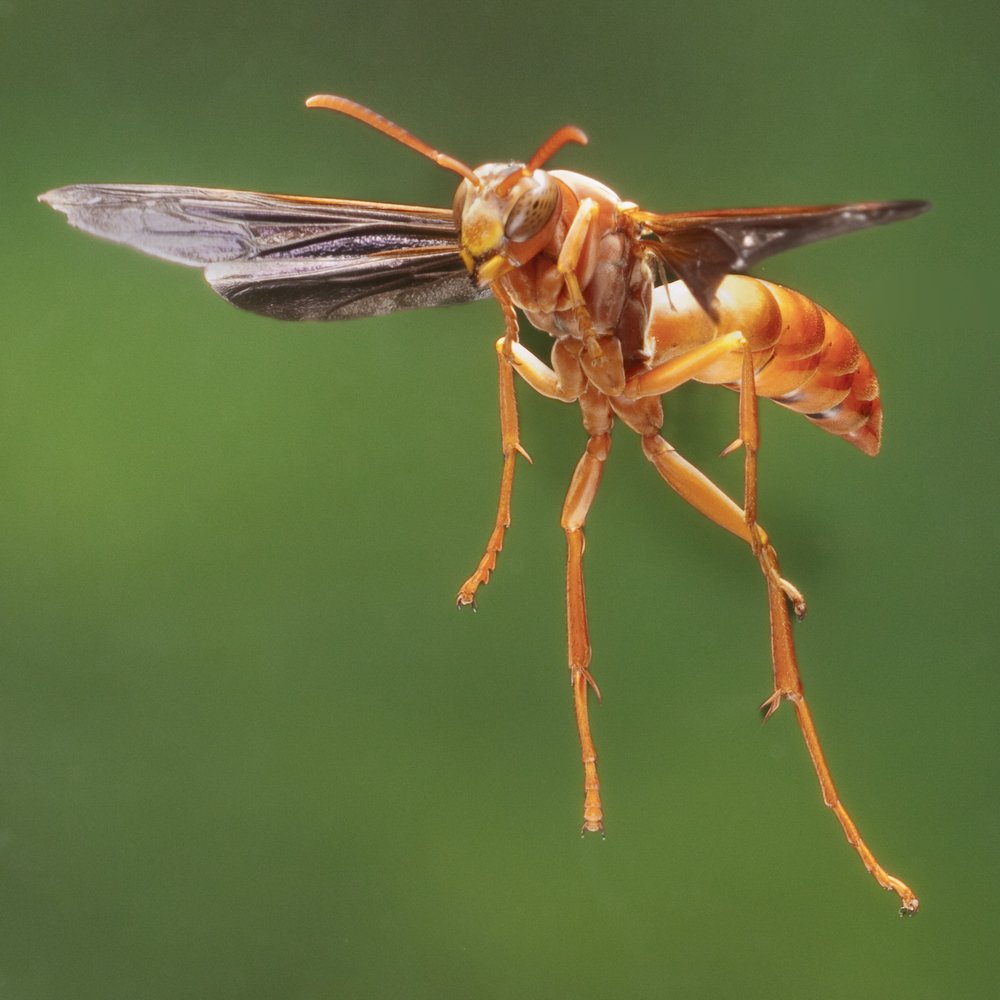
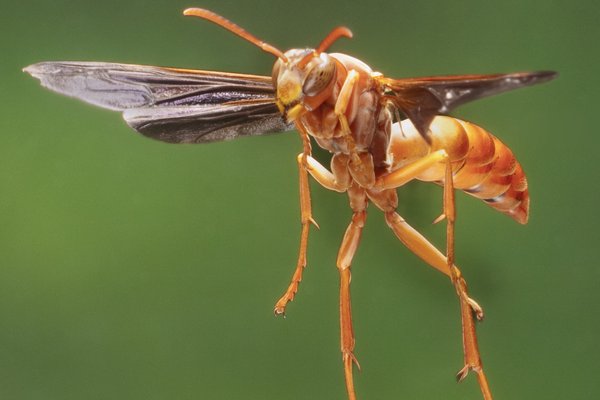
Alas, paper wasps don’t get much positive press. Sure, their jabbing stings can hurt bad enough to trigger tears. Stings aside, though, these narrow-waisted cousins to bees and ants deserve a lot more appreciation for the good they do in nature.
Not convinced? Bear with me and meet one of the more than 20 paper wasp species found in the U.S. As their common name implies, paper wasps construct papery nests from a pulp they make from chewed-up plant and wood fibers mixed with saliva.
Nearly an inch long, our starring species — the fine-backed red paper wasp — occurs in the eastern half of Texas. It has a rusty-red body with black wings and a head that reminds me of a tiny alien. Its life cycle starts with a gyne, also called a foundress. The names refer to a fertilized queen that overwinters in tree bark or cracks in buildings.
In the spring, she chooses a nest site, like under your roof eave. First she builds a thick stalk, to which she attaches her first round of upside-down honeycomb cells. In each one, she lays a fertilized egg. Worker females hatch from these and populate their “eusocial” community. The fancy word means that paper wasps — like some bees and ants — cooperate in tending young and protecting the colony. Workers on the nest, when threatened, shake their front legs in warning. Watch out — they can sting repeatedly and leave red, swelling welts that burn.
In the fall, the gyne deposits unfertilized eggs. These will produce males that mate and die. She’ll also lay fertilized eggs that will become next year’s gynes.
Meanwhile, the increasing numbers of workers enlarge the umbrella-shaped nest and hunt for caterpillars and other soft-bodied insects to feed the young. An occasional spider falls prey, such as an orbweaver that I videoed being attacked by a red paper wasp. After amputating the spider’s eight legs, the wasp winged away, clutching her victim. Back at the nest, I knew the wasp would tear off pieces of the spider to feed the white larvae.
When ready to pupate, the larvae enclose their cells with a silken white cap. After two weeks or so, new paper wasps emerge to hunt and build more cells. As fall approaches, the colony declines, and the wasps die off. Only the young fertilized gynes survive until the next year.
So what about those aforementioned benefits to nature? To start, paper wasps can pollinate flowers (pollen gets on their body while they’re feeding on nectar). They help keep caterpillar populations in check. Their larvae feed scarlet tanagers and other birds, some of which may also eat the adults.
Now and then, a paper wasp may show some personality, too. Like a fine-backed red paper wasp that I once videoed taking a long shower in the water splashing down our fountain’s concrete finial. When the water stopped, she groomed both her antennae with her front legs like a cat for a long while. Then she winged away and returned to her hard-working life as a fine-backed red paper wasp.