Many of us enjoy the amazing variety and abundance of plants Texas has to offer — tall pines in East Texas, swaths of Hill Country wildflowers, rolling prairie grasses and oak woodland up north, spindly ocotillo and sotol out west.
But one plant no one wants to encounter? Poison ivy (Toxicodendron radicans).
Unfortunately, it grows pretty much everywhere in the state. Its toxic oil, urushiol, is absorbed through the skin, and a tiny drop can cause a reaction.
Here’s how to identify poison ivy and what to do if you meet it.
Poison ivy can grow as a vine that climbs other plants and structures, or as a shrub. Look for it especially along rivers and streams and in brushy and forested areas, says professor and Texas A&M AgriLife Extension horticulturist Larry Stein.
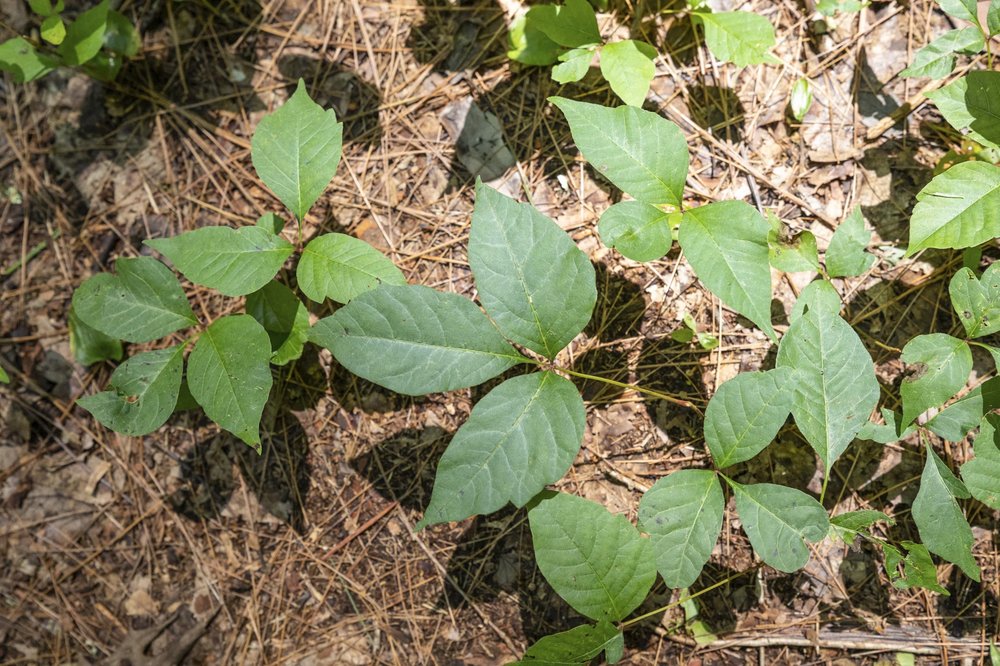
The key to identifying poison ivy is its distinctive sets of three leaves (remember “leaves of three, let it be”).
The plants have small, greenish-white clusters of flowers in spring and white, waxy berries in fall. Leaves are dull or bright green with pointed tips that turn yellow, orange and red in fall. That makes it easier to spot, Stein points out. However, once those leaves fall off, the stems still contain urushiol. The stems have a unique brown color and stand straight up, and Stein recommends becoming familiar with their appearance.
People often mistake other vines such as Virginia creeper for poison ivy, but these lack the distinctive three-leaf sets. Poison ivy isn’t a true ivy, either, he adds, but part of a different taxonomic family (the same one as cashews and mangoes!).
Urushiol is absorbed through the skin in as little as 10 minutes. The oil is invisible and can transfer from hard surfaces, such as hiking boots, and may remain active on those surfaces for several years. Pets can transfer the oil from their fur to you. If the vine is burned, breathing in the smoke can cause a serious reaction. Roughly 80 percent of adults are susceptible, although sensitivity can increase with age. Generally, a rash develops within 24 hours but can take up to a week.
If you contact poison ivy, immediately flush the area with running water. Don’t rub your skin, as that can spread the oil. Then shower with soap and warm water if possible – but remember you only have about 10 minutes before the oil binds to the skin. Wash the clothes you were wearing and anything else that may have touched the plant, such as hiking poles.
Treat the rash with calamine lotion (or a hydrocortisone cream), antihistamine pills, cool compresses and lukewarm baths in colloidal oatmeal or a cup of baking soda. Scratching can lead to an infection. The rash can linger for weeks, and if it doesn’t improve in 10 days, or becomes infected, see a dermatologist.
On the plus side, poison ivy is eaten by some animals, and its berries are food for birds (which, unfortunately, is one way it spreads). The species is hardy, growing in places and conditions that other plants may not.