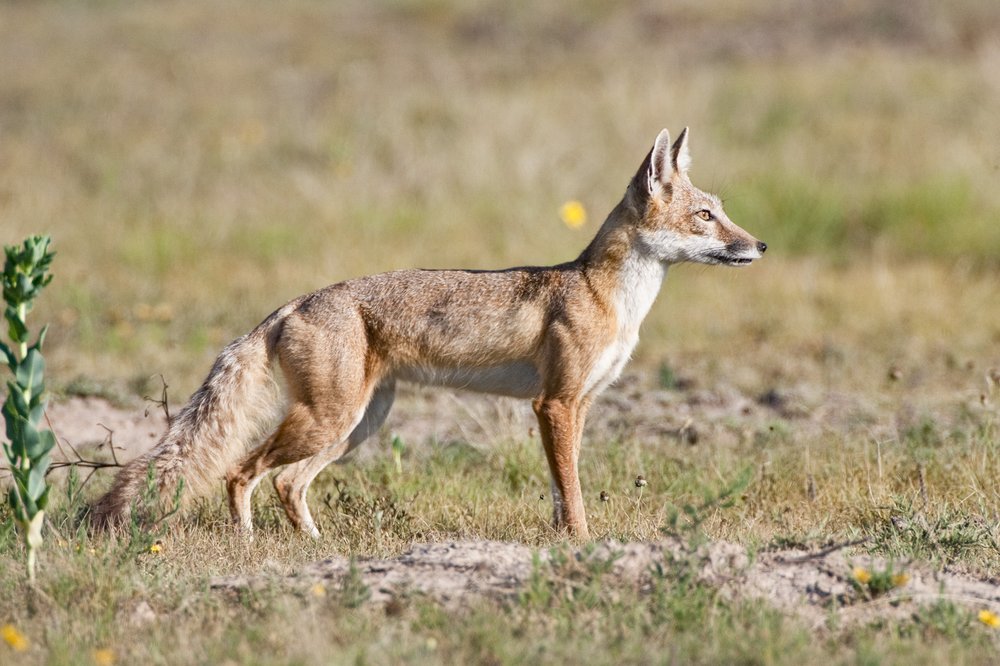
Up in the Texas Panhandle, where the state borders Oklahoma and New Mexico, the open expanse of the Rita Blanca National Grasslands stretches for miles and miles. The land may seem empty at first glance, but take another look. This shortgrass prairie ecosystem is home to a diverse community of wildlife, including a house-cat-sized, buff-colored canid called the swift fox, Vulpes velox.
Swift foxes once ranged in great numbers from the Llano Estacado through the Panhandle and up into Alberta, Canada. But as humans have encroached on their land, the foxes’ populations have fallen. They now occupy only about 40 percent of their historic range, and much of their habitat is fragmented by roads, crop fields and development.
Even in sections such as the Rita Blanca, where large swaths of prairie are preserved, the character of the prairie itself is different now. “These foxes evolved on a landscape that was dominated by big grazing mammals like bison,” says Clint Boal, a professor of wildlife ecology at Texas Tech University. Now that the bison no longer migrate across the prairie in herds several million strong, the grasses grow differently.
A new study conducted by researchers at Texas Tech, Texas A&M, the Texas Parks and Wildlife Department and collaborators is using experimental techniques to find the best way to help Texas landowners manage their property for the success of these cute and charismatic prairie dwellers.
The researchers are learning about fox behavior and biology through direct observation, testing out different land management strategies such as controlled burning and livestock grazing patterns, and experimenting with interventions such as artificial dens and livestock guard dogs (which could help keep away coyotes, one of the foxes’ main threats). They’re also surveying folks who live in swift fox range to understand attitudes toward foxes.
The study is intended to provide a toolkit for landowners who hope to restore their shortgrass prairie land to how it might have been before the arrival of European settlers. “Swift foxes are an iconic animal of the shortgrass prairie, and if we have them on the landscape, we know that we’re doing the prairie right,” says Boal. “If they’re missing, then we’re doing something wrong.”
Managing the Prairie
One key aspect of the study is examining how land management practices can support swift foxes. The historic shortgrass prairie was once maintained by fire and the migrations of large animals. Now that fires are mostly suppressed and bison no longer roam free, the short grasses have given way to taller vegetation.
“Because these foxes are small, they really require a kind of very short-grass prairie, open landscapes, so that they can see predators coming,” says Boal. “When there’s vegetation that gets above 12 inches, it’s much easier for coyotes or other predators to hunt and ambush foxes. They can see over vegetation to find foxes, then hide again. The foxes just aren’t tall enough to see them.”
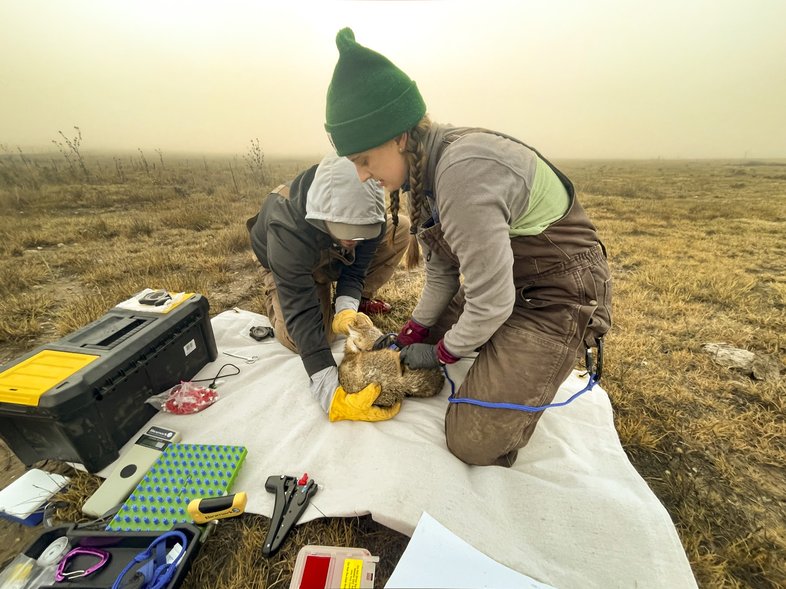
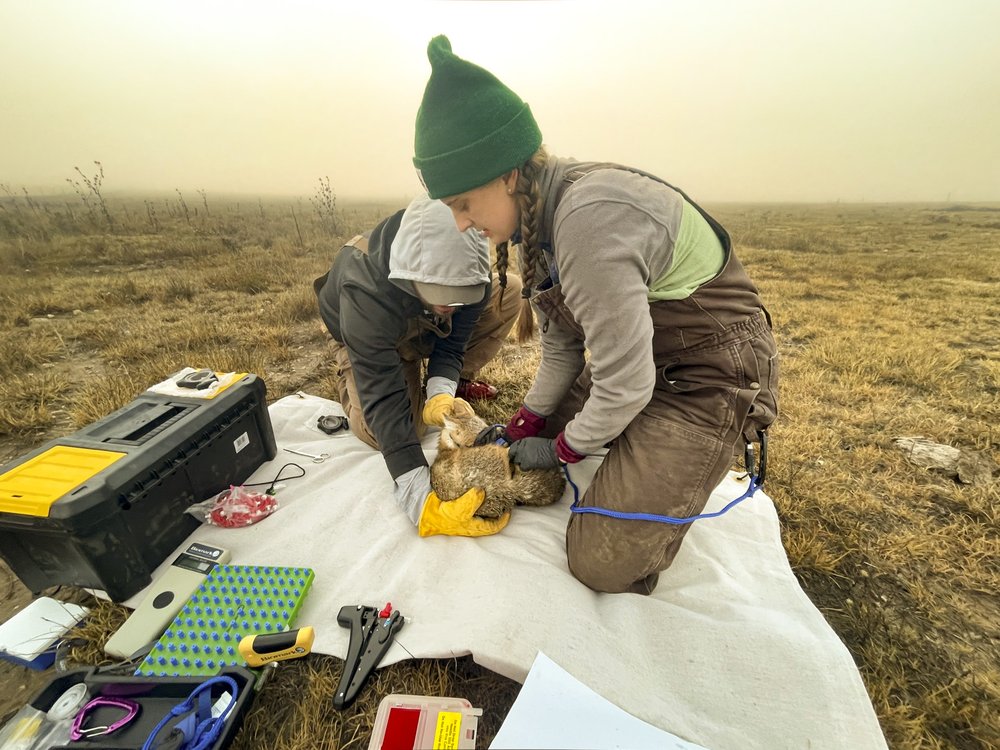
Researchers Jonathan McClellen, left, and Katja Bastiaens collar and collect data from a captured swift fox.
Haley Sloan | Texas A&M
Researchers Jonathan McClellen, left, and Katja Bastiaens collar and collect data from a captured swift fox.
Haley Sloan | Texas A&M
The researchers are planning to conduct experiments at Rita Blanca to test how much prescribed fire and livestock use are ideal for swift foxes. “[We’re looking at] how we can adapt to management practices of short but intense periods of grazing or prescribed fire, both of which were natural factors on the range — and see, will the foxes increase their use of those areas, or go into those areas if we never detected them there before?” says Boal.
How to Increase Survival
Beyond prairie management, the researchers are also investigating other ways of increasing swift fox survival. For the pint-sized foxes, one of the main threats is coyotes.
Worldwide, wild canines often attack and kill the next size down. They rarely eat them. Wolves kill coyotes and jackals, coyotes kill foxes. This is also true of Panhandle coyotes with swift foxes — they appear to be killing them, but rarely eating them. “We don’t really know why the coyotes don’t appear to eat them,” says John Tomeček, an expert on carnivore ecology and associate professor at Texas A&M. “Although many suspect this is because coyotes think foxes are competing with them for food, recent research shows that this is not true.”
The researchers, headed by Tomeček, are investigating whether livestock guard dogs (LGDs) could help protect foxes from coyotes. “Because wolves exclude coyotes in natural systems, livestock guard dogs work like a ‘wolf that works for you,’” says Tomeček. Guard dogs have been used to protect domestic livestock such as sheep and goats from predators.
“Very few people have ever used LGDs to protect wildlife before — this is really exciting and really innovative,” says Tomeček. “Because both cattle and swift foxes prefer short grass — and swift foxes don’t hurt cattle — this could be a good match for every species involved.”
In addition to livestock guard dogs, the team is also investigating fox denning practices, and whether the addition of artificial dens could be helpful. A single fox may frequent several different dens, and may dig the dens itself or use an abandoned den left by another animal.
“These dens are used as escape from coyotes or other predators. They’re used as shelter in the winter. They’re used just for sleeping at night, but importantly, they’ll be used for making baby foxes,” says Boal.
The artificial dens, made from sturdy inverted buckets, may help foxes breed and avoid predation on the prairie. The experiment is still underway, so only time will tell. To collect data, the researchers have installed game cameras to monitor den use.
Over the past two years, the researchers have been catching foxes, taking measurements and fitting them with GPS collars. They’ve also taken ear punches to do genetic studies, as well as tested the animals for dog-family diseases such as parvo and canine distemper. The collars will help the researchers determine the ranges and movement of each fox, and will provide insight into how various experimental conditions will affect individual animals.
In a third aspect of increasing fox survival, the researchers are talking with people living in swift fox country to get an idea of the human aspect of the issue. They want to understand what people know about these elusive, iconic foxes, and how they feel about efforts to help their conservation. Understanding people’s attitudes toward the foxes could help guide education and outreach efforts to help preserve this iconic species going forward, as well as build support for community-driven conservation efforts.