The next time you dig into a delicious plate of seafood, thank a shark. These top predators help maintain the health of the Gulf and the seafood that comes from it.
Though critically endangered, the scalloped hammerhead (Sphyrna lewini) is one of the 10 most common shark species in Texas waters, according to Kesley Banks, a research scientist at the Harte Research Institute’s Sportfish Center, along with blacktip, bull and great hammerhead sharks.
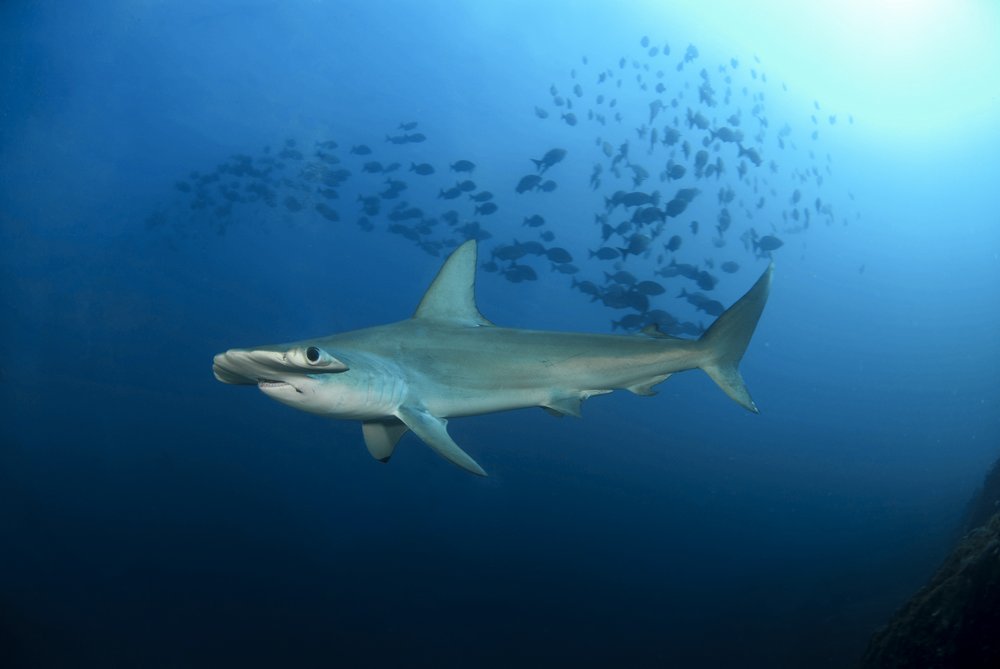
A flat head – featuring notches on the front for which they are named – and widely spaced eyes help these sharks locate prey on the sea floor. The wide placement of eyes and sensory organs on their head give them a expansive field of vision and enhanced ability to detect electrical fields of prey.
Your best chance to see one is if an angler fishing in the surf catches one.
“They are caught frequently from the shore,” Banks says. Unfortunately, hammerheads have a high likelihood of dying when caught and released. “There is a greater than 50 percent chance that if you catch one, it [won’t] survive. That said, we have some that have been caught from the beach multiple times.”
Several factors come into play, she adds – most importantly whether anglers follow best handling practices, including keeping the shark’s gills in the water and landing the fish quickly. Hooked hammerheads also are more likely to die in summer, when water temperatures are higher. Successful catch-and-release is important because scalloped hammerheads are critically endangered.
Scalloped hammerhead sharks can grow up to 14 feet long and more than 300 pounds, with females larger than males.
Females give birth to live young, and the pups spend several years in bays and other coastal habitat before joining adults in open ecosystems such as deep reefs and seamounts.
Social creatures, hammerheads form large schools, which often are sighted from January through March in the Gulf, including in the Flower Garden Banks National Marine Sanctuary. Schools of scalloped hammerheads display complex social structures with distinct hierarchies. This species mostly eats fish, but “will eat anything that swims in front of them,” Banks says.
Fortunately, they pose little danger to humans. For one thing, hammerheads have relatively small mouths. For another, you are statistically more likely to be killed by lightning (around 1 in 80,000 odds) than to be killed by a shark (1 in 4.3 million odds). In fact, more people are hurt driving to and from the beach than by sharks in the water. In 2023, only 10 people died from shark attacks while about 80 million sharks died at the hands of humans.
The Sportfish Center operates the largest shark-tagging program in the western Gulf. The 6,000-plus sharks it has tagged include Bill Nye the Science Shark, an 8-foot-long, 200-pound male hammerhead tagged in March 2016 off the Padre Island National Seashore beach, and Buddy, a 7-foot, 10-inch 170-pound male tagged in November 2015 off Mustang Island.
These tags generate data on feeding habits, movement patterns and distribution of sharks in the Gulf, knowledge that helps scientists figure out how to protect these important predators.
“If you like eating seafood or looking at pretty coral reefs, you want these sharks in our waters,” Banks says. “Marine ecosystems are healthier when they are there than when they are not.”