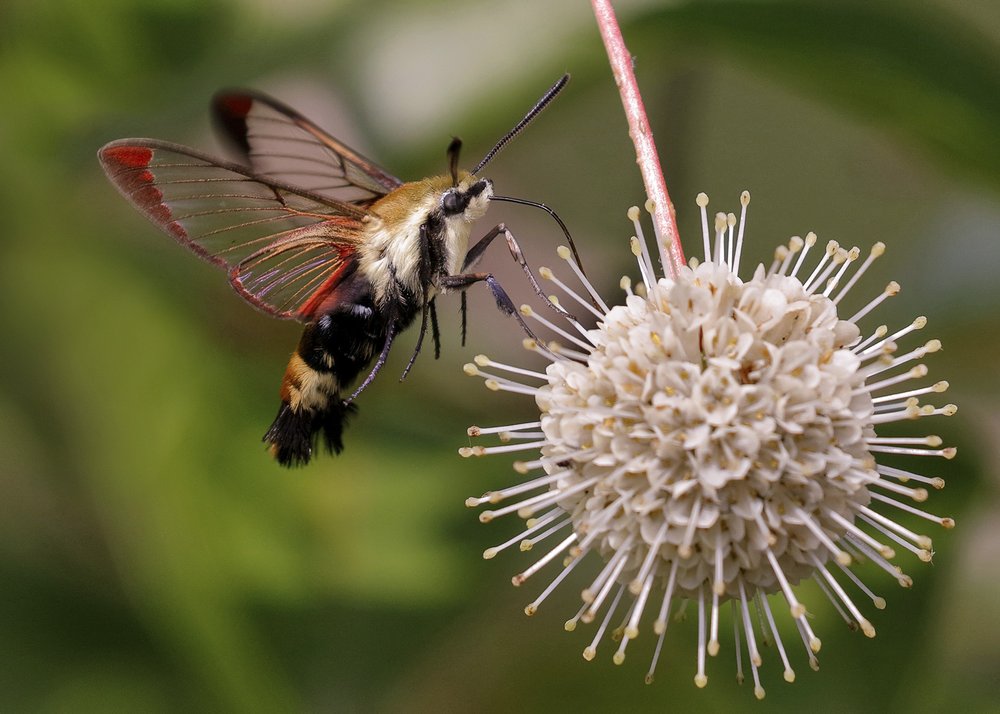
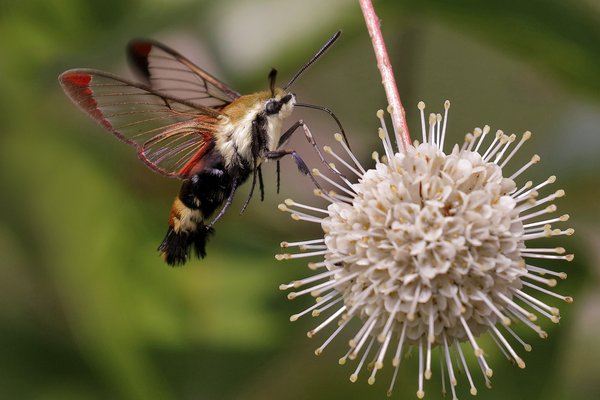
You might have seen one in the daylight hours, dallying and dancing on whirring wings, delighting in the nectar each bright blossom brings. With this fluttery figure sporting yellow and black bee-like stripes, you may have even considered the risk of a sting. But fear not — closer inspection reveals it to be a harmless snowberry clearwing moth. Its bumblebee mimicry presumably helps to discourage predators, including birds, spiders and praying mantids.
Just as “clearwing” describes the moth’s transparent wings, other common names are reflective of their appearance: bumblebee moth, hummingbird moth and flying lobster. They are sometimes mistaken for hummingbirds as they sip nectar on the wing — hovering rather than landing on blossoms like a bee. Their wings even produce an audible hum as they beat up to 85 times per second. To me, the spreading tails of their fuzzy abdomens resemble crayfish tails.
Unlike most moths, clearwings are diurnal, making them easy to observe. Look closely to watch them unfurl their coiled proboscis — a long, tubular mouthpart — and insert it deep into flowers to feast on the sweet nectar. Because they possess an extra-long proboscis, deep, tubular blooms are this pollinator’s specialty.
Snowberry clearwings are easily attracted to home gardens, whether in rural or suburban areas. Some of their most irresistible nectar plants are beebalm, phlox, lantana, honeysuckle, verbena, thistle and goldenrod. Their larvae can be green or brownish-black with dark spots (spiracles) running along the sides. A thin yellow collar runs across the head, while a spiky horn juts upward from the rear section. Host plants for the larvae consist primarily of honeysuckles, as well as the namesake snowberries. The larvae overwinter in a cocoon, often beneath leaf litter, except in the deep South, where adults can be found year-round.
Ranging throughout much of Texas, snowberry clearwings are most heavily concentrated in the northeastern and central regions of the state. Another species of clearwing can be found in Texas, the hummingbird clearwing moth (Hemaris thysbe). It is especially prevalent in the Hill Country. Colored olive-green and burgundy, it resembles a hummingbird more than a bee. Like the snowberry clearwing’s mimicry, the hummingbird clearwing’s impersonation of hummingbirds could possibly deter potential predators. Its larvae prefer viburnum species as host plants.
From spring through fall, be on the lookout for the beguiling snowberry clearwing wherever flowers flourish. Suspended on whispering wings, you are sure to enjoy the delight they bring.