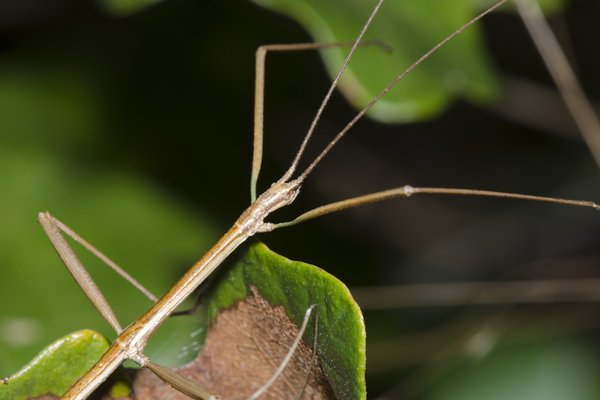
One June morning a few years ago, while hiking along the Barton Creek Greenbelt in Austin, a branch on a tree in front of me moved in a weird way.
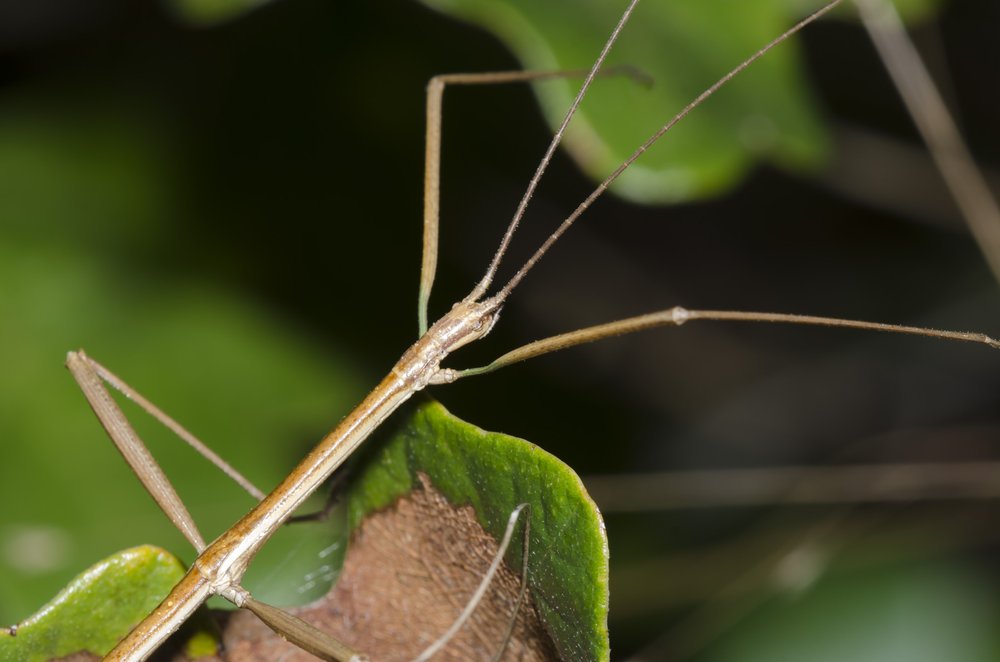
I looked closer and realized that it wasn’t a branch, but a stick bug the size of a pencil. In fact, it was two of them, clasped together, enjoying a private moment right there on a public trail.
After spending more than a few minutes admiring the insects, my husband and I continued walking. We quickly realized that the amorous stick bugs, also called walkingsticks, were not alone.
We found stick bugs trundling across the trail, clinging to leaves and strolling through the underbrush. In all, we spotted at least 15 pairs and another dozen roaming the woods solo. It felt like we were living a bug-focused episode of the 1960s TV show Mutual of Omaha’s Wild Kingdom. Curious to learn more about the spectacle, I checked in with entomologist Molly Keck at Texas A&M AgriLife in San Antonio.
Walkingsticks are members of the order Phasmatodea and are found on every continent except Antarctica.
More than 3,000 species have been identified globally, and the island of Borneo is home to over 300 varieties alone. A walkingstick found in southern China, Phryganistria chinensis, is the world’s longest insect, measuring up to two feet in length with legs fully outstretched.
At 7 inches long, the giant walkingstick (Megaphasma dentricus) is the longest insect in the United States and among the most commonly spotted in Texas. An additional 15 species can be found in the state.
For stick bugs, it’s all about camouflage. Their body shape, resembling sticks and twigs, helps hide them from predators.
They feed on plant material, including leaves from oak, pecan and hackberry trees, all common in Central Texas.
Texas A&M Forest Service notes that a few mass defoliation events have occurred in East Texas, though even these events are not particularly damaging as trees can recover in the following year.
You can spot stick bugs any time of the year, although every few years temperature, rainfall and other conditions trigger “outbreaks,” which is what I saw. That display occurred the morning after a downpour, and Keck thinks the storm might have knocked some out of the trees.
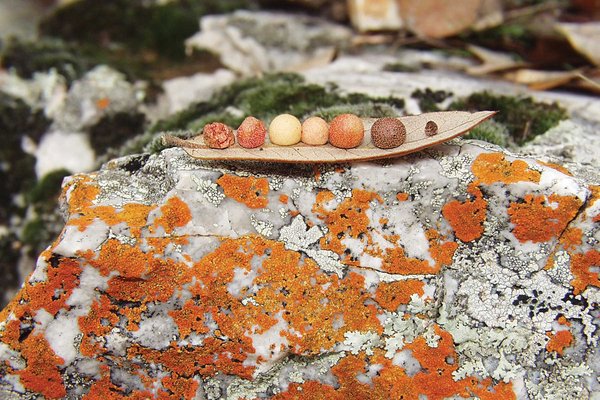
Stick bug eggs resemble seeds — oval shaped and smaller and flatter than a peppercorn. A tiny lid pops off the egg when it hatches, freeing a stick bug about the size of a needle, which unfurls and emerges. The stick bug undergoes a series of molts over the next year, growing progressively larger.
“They’re really cool,” Keck says. They’re also quite strong. One of Keck’s co-workers once noticed a stick bug attached to the hubcap of her vehicle. After driving 30 minutes to work, it was still hanging on.