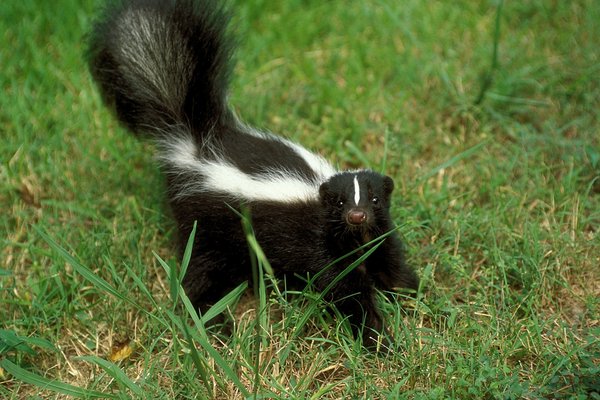
Nobody ruins a party like a skunk.
When Texas Parks and Wildlife Department mammalogist Jonah Evans came across a road-killed spotted skunk and decided to save the specimen in the freezer at work, his co-workers were less than enthusiastic.
Needless to say, there were no ice cream cakes in Evans’ immediate future.
Evans’ sticky note that said “Do Not Eat” on the skunk’s Ziploc bag wasn’t too funny either.
“All the people at work were frustrated because they wanted to use the freezer, and I just took a long time to hand the skunk off to Bob Dowler,” Evans says.
Most people think a skunk is a skunk is a skunk.
Robert Dowler, Professor at Angelo State University
A year later, he finally got rid of the skunk, though the use of the freezer never quite returned to pre-skunk levels.
OK, but who is Bob Dowler, and why did he want a frozen skunk?
Robert Dowler is one of the world’s leading skunk researchers, and he oversees one of the world’s biggest skunk specimen collections. He is a professor at Angelo State University in San Angelo, which, it turns out, is practically the epicenter of skunkdom in Texas.
Texas has five species of skunk — more than any other state — and that makes Texas a darn good place to study skunks, if you’re into that kind of thing. Bob Dowler is.
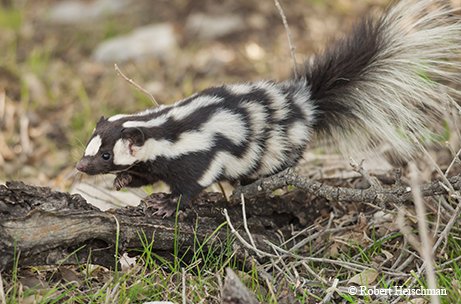
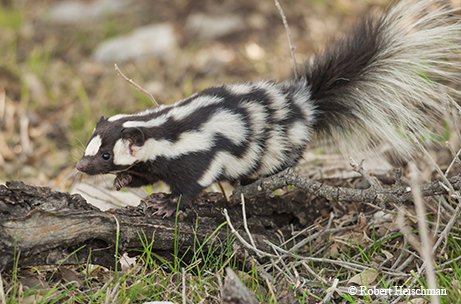
A western spotted skunk is released after being studied.
Robert Heischman
A western spotted skunk is released after being studied.
Robert Heischman
All the people at work were frustrated because they wanted to use the freezer, and I just took a long time to hand the skunk off to Bob Dowler.
Jonah Evans, Texas Parks and Wildlife Department Mammalogist
“There’s all these questions we’ve answered about raccoons, coyotes, all these other species,” Dowler says. “There’ve been all kinds of studies done. When it comes to skunks, there’s lots of room for asking questions that haven’t been answered because there’s a certain ... Well, I get that from a lot of people: Why on earth would you work with skunks? But I’ve been fascinated by them for a long time. They’re amazing little animals.”
Working with skunks certainly comes with occupational hazards that you don’t encounter in working with, say, butterflies or kangaroo rats.
The spraying of the extremely foul-smelling fluid from the tail end of a skunk is something that predators, and spouses of skunk researchers, don’t soon forget.
“My wife is very tolerant,” Dowler says.
Skunks are an important part of Texas’ wildlife. Texas has just one species of opossum, one species of raccoon and one species of armadillo. With five species of skunks, that makes them kind of special, if you appreciate that kind of thing. Bob Dowler does.
“Most people think a skunk is a skunk is a skunk,” Dowler says.
Skunks used to be grouped in the same family as weasels, but in the 1990s, genetic work led taxonomists to group North American skunks and Asian stink badgers into their own separate family.
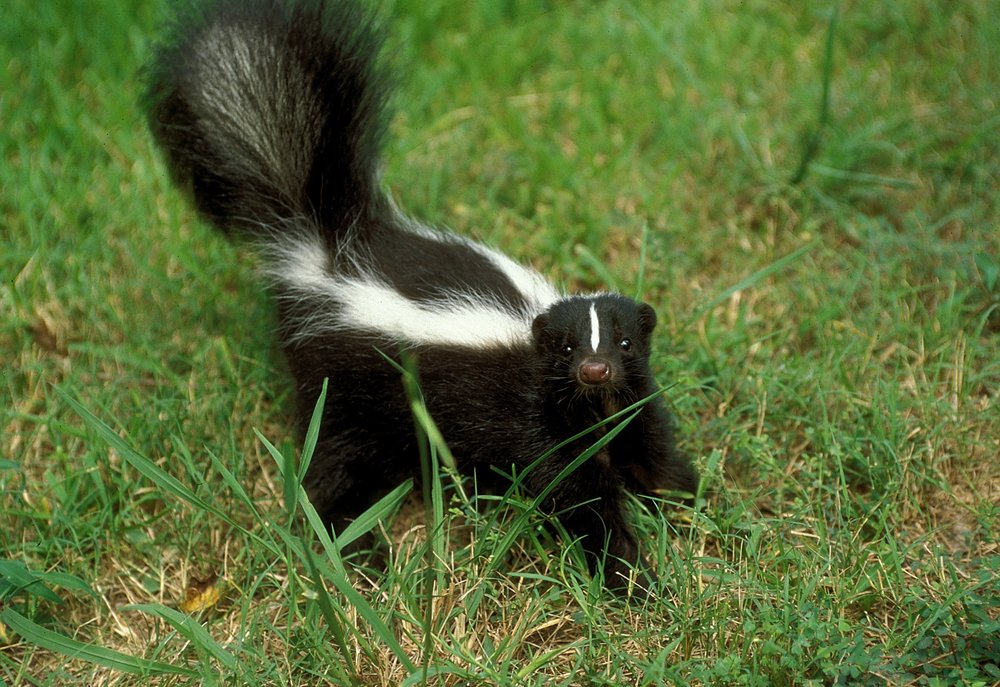
Everybody knows the common striped skunk, with its black body and white stripes and its reputation for spraying predators and pet dogs. There’s also the hog-nosed skunk, with its long snout and single broad white stripe down the back, found in the Edwards Plateau and Trans-Pecos regions. And there’s two species of spotted skunk: the western and eastern. Spotted skunks have spots on their heads and other parts of their bodies; they are smaller and more agile than other skunks and can climb trees. And finally, there’s the hooded skunk, a much less common species found only in the Big Bend region. It’s similar to the striped skunk but with longer fur and a ruff of hair on the upper neck.
All of the species have the distinctive white-and-black coloring that serves as a warning to predators.
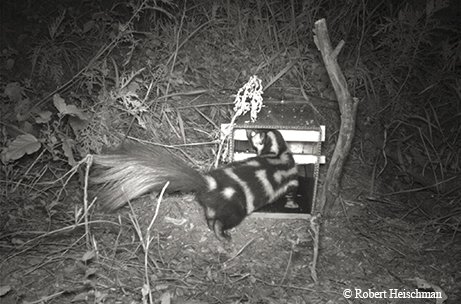
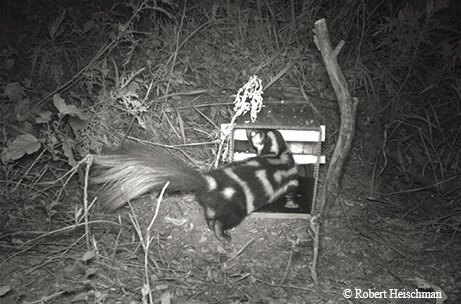
A spotted skunk is captured on a trail camera.
Robert Heischman
A spotted skunk is captured on a trail camera.
Robert Heischman
On the trail of the spotted skunk
The species of greatest conservation concern is the eastern spotted skunk, or plains spotted skunk, which is found in the eastern half of Texas and the Panhandle and in the eastern United States. The U.S. Fish and Wildlife Service is considering listing it as a threatened or endangered species.
Spotted skunks aren’t your typical skunk.
“Most other skunks are kind of heavy-bodied and not very aware,” Evans says. “They lumber around, and if a predator shows up, they have their defenses, and that’s their game. Spotted skunks are more like a skunk crossed with a squirrel. They bound all over the place, and they can climb trees pretty well.”
Their markings are different, too. Spotted skunks have multiple, broken white stripes, plus spots on the rump and the head.
The eastern spotted skunk was once a widespread species across the midwestern and southeastern states, with harvests exceeding 100,000 animals a year for pelts. In the 1940s, populations seemed to crash across the animal’s range. Texas put the plains spotted skunk on its watch list and awarded Dowler a contract to assess its status.
It’s a real goat-rope to catch these things.
Robert Dowler, Professor at Angelo State University
Dowler’s team is in the process of surveying 10 sites to find where the eastern spotted skunk is, and isn’t. At each site, his team uses 120 traps or detection devices, checked daily during a weeklong survey.
Since the animal is being considered for endangered species status, that means finding one can be akin to searching for Bigfoot. Dowler and his students surveyed a site in Fort Worth for a week and found no spotted skunks, despite a trail camera having shown one there earlier in the year. At Lake Somerville State Park, a week’s worth of trapping and camera surveillance turned up no spotted skunks either. They were getting — you guessed it — skunked.
In Waller County, too, things had been looking bleak. Dowler and his graduate students Clint Perkins and Alex Shaffer had suffered through four days of empty traps, stolen bait and inadvertently trapped raccoons and opossums. But when they were making their rounds on the fifth day, they saw something.
“The grass was pretty thick, and we couldn’t see into the trap,” Perkins says. “We could just see that the trap was closed. And we could see that the animal had pulled grass into the trap to make a little nest. We gently lifted the cover and saw that a skunk had wrapped itself in the grass. Alex was the first one to tell that we had a spotted skunk.”
Shaffer interjects: “I did a little dance.”
Perkins goes on: “I let out a little woo-hoo.”
They found another spotted skunk two days later, on the survey's last day.
Dowler and his students will wrap up their work in spring 2017. The Texas data will be added to data from other states, leading to a decision on whether or not to list the species.
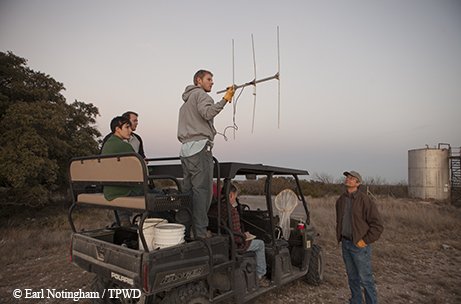
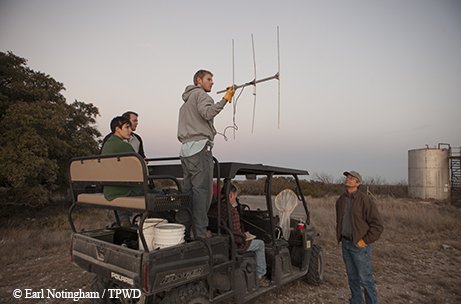
Angelo State students track radio-collared skunks.
Neil Nottingham | TPWD
Angelo State students track radio-collared skunks.
Neil Nottingham | TPWD
Don’t lift that tail
The most well-known skunk characteristic is, of course, its ability to spray.
Dowler must be some kind of skunk whisperer.
“I try to avoid being sprayed,” he says. “Either I’m careful or I’m smart. To be honest, I haven’t been sprayed much at all.”
Plus, he has graduate students to catch skunks for him.
“I’ve been sprayed quite a few times now,” Perkins says, “and I don’t worry about it anymore.”
The hog-nosed skunk presents a particular risk, mostly because of its method of capture. The other skunk species can be trapped, but the hog-nosed typically won’t go into a trap. That means the researchers basically have to chase them down.
“It’s a real goat-rope to catch these things,” Dowler says.
From the back of a pickup, they patrol properties at night, when the skunks are out, and scan the countryside with spotlights and flashlights. When they see one, they’ll bang on the roof of the pickup, yell “Skunk! Skunk!” and jump out in a mad dash to capture the skunk.
For the skunk, there’s no better time to spray than when a handful of Angelo State students are chasing you with nets and buckets.
All carnivores have anal scent glands, and animals such as weasels and badgers have enlarged anal glands that can be used for defense. Skunks not only have bigger anal glands, they also have the ability to spray their scent from nipples that can be precisely aimed and controlled.
Initially, the smell is overbearing, but you get used to it.
Robert Dowler, Professor at Angelo State University
When a skunk is being chased, it can emit an atomized cloud that the pursuing predator must run through. When a skunk is under a bush or cornered, it can aim a direct stream of yellow discharge at a predator’s face. Both are effective methods of deterring an intruder. The active ingredient of the foul-smelling discharge is a sulphide known as n-butyl mercaptan, which can sting the skin, cause temporary blindness and produce a pungent, gagging odor that is unmistakably skunk.
In a bit of self-loathing, it turns out skunks can’t stand the smell either.
Skunks often issue warnings before spraying. Striped and hooded skunks stomp their feet. Hog-nosed skunks may rear up on their hind legs. Spotted skunks get acrobatic and perform a handstand with their tail aloft.
When a skunk is ready to spray, nozzles emerge from either side of the skunk’s anus. Each nozzle is surrounded by muscle tissue that can contract to direct the discharge 15 feet or more with highly coordinated control.
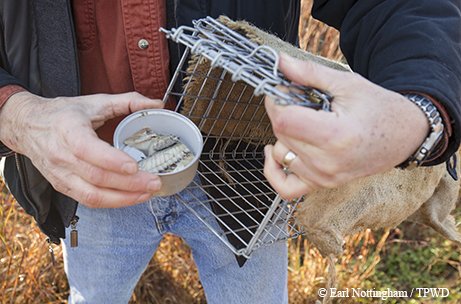
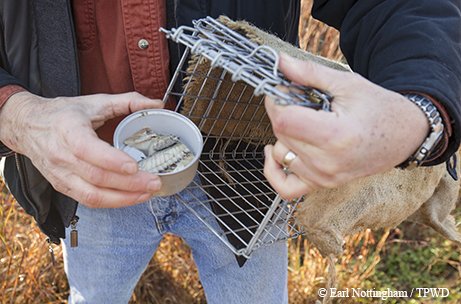
A trap is baited in hopes of catching an eastern spotted skunk.
Earl Nottingham | TPWD
A trap is baited in hopes of catching an eastern spotted skunk.
Earl Nottingham | TPWD
On the road again
If it was Saturday, it was time to count the roadkill.
For 15 months in the mid-2000s, Dowler and Angelo State colleague Terry Maxwell drove a 100-mile route near San Angelo every two weeks documenting roadkill as part of a study.
It’s a habit that’s been hard to break.
“I can’t drive anywhere now without looking at the roadkill,” Dowler says.
For Dowler and Maxwell, roadkill can provide a treasure trove of mammalian information.
Sooner or later, unlucky members of the various species of mammals in Texas — skunks, foxes, porcupines, armadillos, raccoons, etc. — are going to end up smashed along a roadside. And certain information, such as population numbers and presence of wildlife corridors, can be gleaned from these dead animals, if you want to know such things. Bob Dowler does.
Dowler and Maxwell found that the number of road-killed skunks increases dramatically in February and March — breeding season. Sex-crazed males embark on nighttime quests to find mates, and if they have to cross a highway, they just might not make it.
Dowler’s other research hasn’t been quite so gruesome.
Most of the research questions he asks are ecological. How do skunks live their lives? What do they eat? How far do they roam?
Dowler and his students have been systematically collecting such information, especially on western spotted and hog-nosed skunks, since those species have been studied less than striped skunks. In one three-year study funded by TPWD, Dowler monitored the comings and goings of striped, western spotted and hog-nosed skunks at San Angelo State Park.
Dowler and Evans both want to know more about how the different skunk species divide up habitat.
“I’m interested in how they partition their niches so they’re not competing,” Evans says. “In Big Bend National Park, in one creek bed I found the tracks of spotted, hog-nosed and striped skunks all within a few feet of each other. That’s three skunks cohabitating in the exact same area. But they all have their own approach.”
As part of his research, Dowler oversees the mammal section of Angelo State’s Natural History Collection, which contains 18,000 mammal specimens and a world-class compilation of skunks. Once a year, Dowler and his students set aside a very stinky day to prepare skunk specimens for the collection. They take the frozen skunks that they’ve accumulated through the year (such as the one from Evans) to a property outside of town, where they thaw them and skin them.
“Initially, the smell is overbearing,” Dowler says, “but you get used to it.”
Occasionally, students are sent into town to pick up food for everyone. They are encouraged to use the drive-through lane.
The specimens and their associated information (location, species, etc.) can be investigated for trends, anomalies and so on, providing a historical window on wildlife, if you want to study such things. Bob Dowler certainly does.
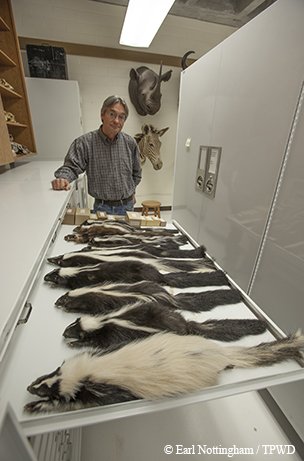
Skunk specimens in the San Angelo collection.
Earl Nottingham | TPWD
Skunk specimens in the San Angelo collection.
Earl Nottingham | TPWD