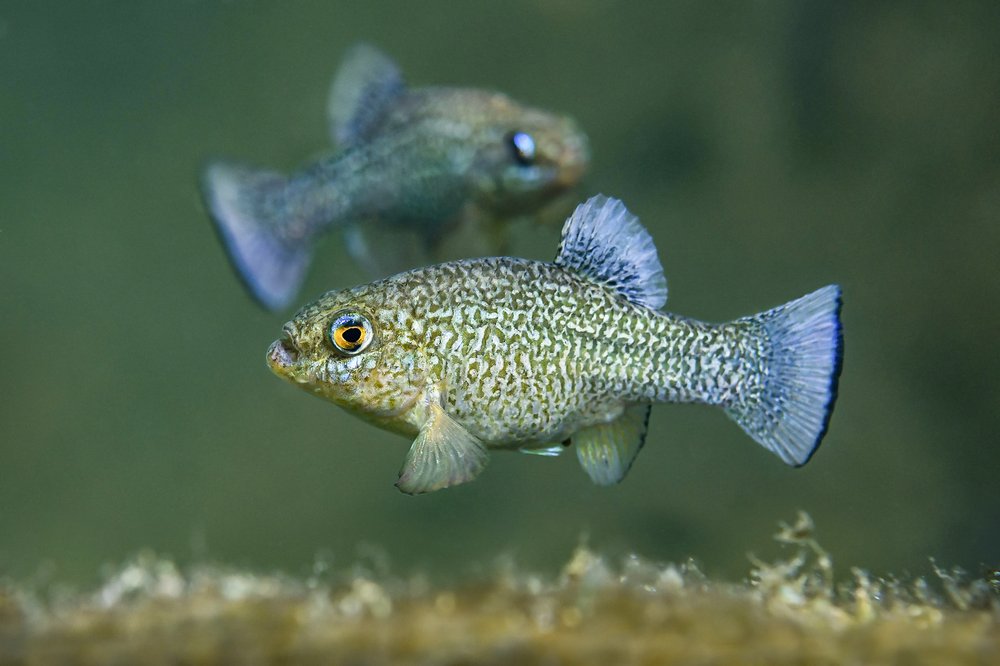
Few swimming pools offer bathers potential encounters with a live fish, especially not an endangered one. And Balmorhea State Park’s pool is the only one in the world occupied by the tiny endangered Comanche Springs pupfish (Cyprinodon elegans).
Less than two inches long, these fish are tan and speckled, the males slightly blue with a shiny stripe on their side. They live one or two years.
The species is named after a once-sprawling complex of springs — Comanche Springs — that it called home in the West Texas town of Fort Stockton. Historically, the pupfish occurred in Comanche Springs and a group of springs near Balmorhea.
Humans likely began gathering around these waters as long as 11,000 years ago. In the 1800s, farmers used the water to raise crops, making modifications to the wetland that reduced the pupfish population. Later, people pumped out groundwater for agricultural and other uses, drying up several of the springs, most notably Comanche Springs, reducing the historical habitat for this pupfish by nearly half.
The State Parks Board, predecessor to the Texas Parks and Wildlife Department, acquired about 46 acres around San Solomon Springs in 1934. The Civilian Conservation Corps built facilities for Balmorhea State Park, including a 25-foot-deep, 1.3-acre pool, further altering pupfish habitat.
The Comanche Springs pupfish was listed as endangered in 1967 and today lives in waters within San Solomon Springs complex, which includes Balmorhea State Park and the Nature Conservancy’s Sandia Springs Preserve, plus nearby Giffin Springs and Toyah Creek. Between 1974 and 2005, TPWD built three wetland areas in the state park: the Balmorhea State Park refugium canal, San Solomon Ciénega and Hubbs Ciénega.
“The ciénegas were built to give the pupfish a place to live, and they are doing very well in the park,” says Nicolas Havlik, a TPWD natural resource specialist. “We also follow a habitat conservation plan to ensure the survival of the endangered species in the park.”
Produced by a working group of scientists formed in 2016 by TPWD, the San Solomon Springs biomonitoring plan outlines research and monitoring efforts. The plan also aims to work with the area’s active oil and gas industry to minimize its potential to diminish spring flow or affect water quality. A nearby United States Geological Survey station monitors the flow and depth of water coming out of the pool, and a Texas Commission on Environmental Quality station in the park collects data measuring water quality.
More than 15 million gallons of cold, clear water gush from the springs into the park’s pool and ciénegas every day. It is likely that thousands of pupfish now live in that water, and, even though they’re small, visitors can easily spot them. If it is up to Havlik, that won’t change. “We want to be good stewards of the springs, to live up to our mission statement to manage and conserve the natural resources in Texas,” he says. “Balmorhea is such a unique place, and the pupfish are part of it.”