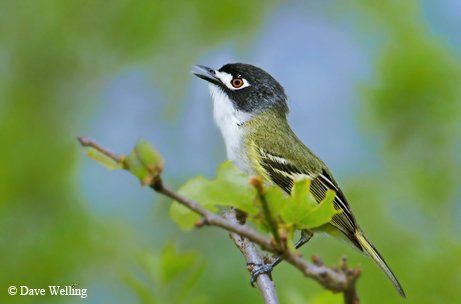
I had arrived at Lost Maples State Natural Area just after dawn. It was my first visit here, and, like most out-of-state birders, I had made the pilgrimage primarily to see one of Texas’ most iconic birds: the black-capped vireo. It was a worthy goal. Not only is the black-capped relatively rare, it is one of America’s most beautiful songbirds.
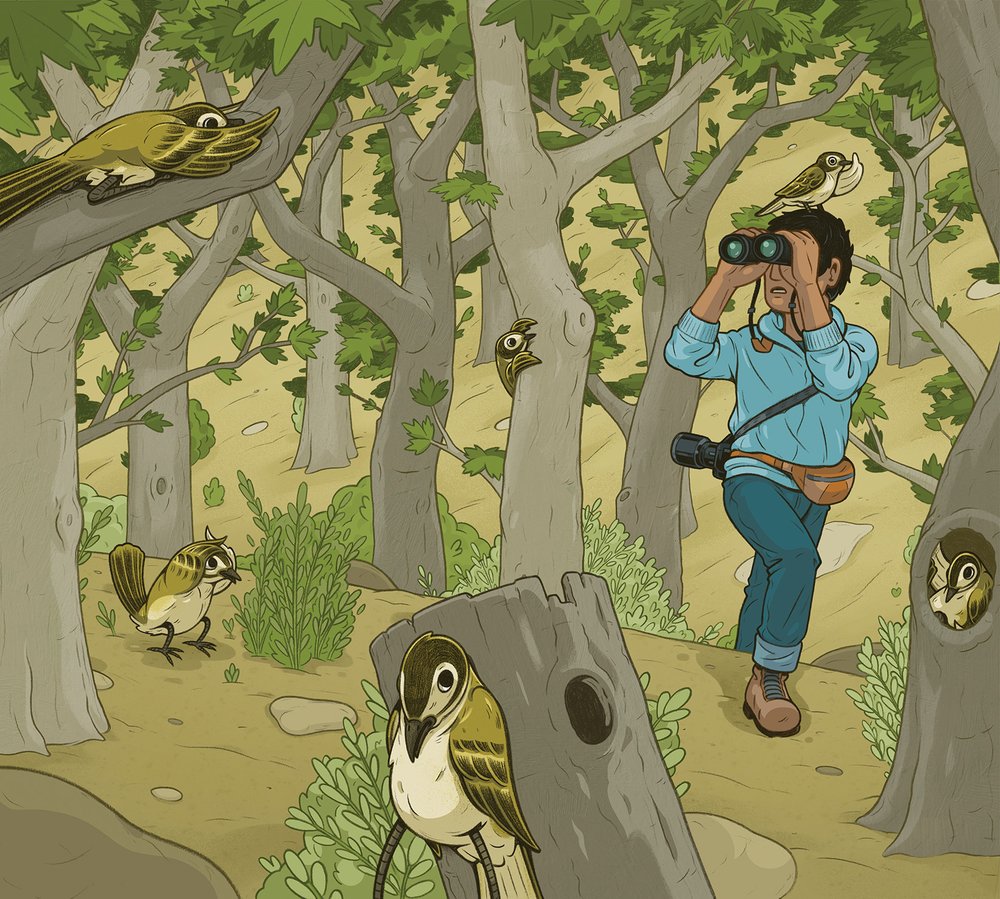
It once bred extensively from northern Mexico all the way into Kansas, but today its major stronghold resides in the Texas Hill Country. After parking my rental car, I strapped on my fanny pack full of water and snacks, slung my camera and binoculars across my shoulders and set out on the East Trail.
As I hiked, bird song rang through the oak and scrub woodland surrounding me. I am lousy at identifying bird songs, so I stopped frequently to run the Merlin app’s Sound ID feature. This incredible tool, created by the Cornell Lab of Ornithology, uses AI technology to identify bird vocalizations in real time, and I often use it to detect which bird species might be lurking nearby. Today, it identified the calls of half a dozen songbirds, including another Texas Hill Country specialty, the golden-cheeked warbler. Then, it identified a vireo — but not the one I had come to find. Instead of a black-capped vireo, the app alerted me to a singing red-eyed vireo. I listened and, sure enough, heard a scratchy call resembling that of an American robin having a lazy day.
Farther up the trail, Merlin picked up a different vireo — again, not the one I’d come to see. This one was a white-eyed. Shortly after that, I raised my binoculars to examine a shape moving through nearby bushes. This bird had a bluish head and white “spectacles” around its eyes — a blue-headed vireo!
I eventually found a pair of black-capped vireos, the species I’d originally traveled so far to see. But I also left Lost Maples that day with a refreshing new perspective on what may be America’s most underappreciated group of songbirds.
Subtle Beauty
Vireos belong to the bird family Vireonidae, which also includes shrike-babblers, peppershrikes, greenlets and shrike-vireos. Although some species of this family occur in Asia, the 34 members of the genus Vireo are strictly New World species. What’s more, of the 16 vireo species regularly found in the U.S., an incredible 14 occur in Texas at least some time of the year. At least 11 of those breed — or have bred — here. That, hands down, crowns Texas as the vireo capital of the United States!
Unfortunately, vireos don’t often get their fair share of attention. Houston-based birding guide Glenn Olsen explains that vireos can be secretive and hard to find. Compared to some other songbirds, vireos also can appear rather drab. “They’re not as colorful as warblers or orioles and tanagers,” Olsen says, “but that’s what I like about them. To me it’s like appreciating a watercolor compared to an oil painting or acrylic painting — warblers being the acrylic paintings and vireos being the watercolors.”
While some vireos such as the yellow-throated and black-capped can sport impressive color schemes, most tend toward a grayish color palette with brushstrokes of watercolor yellows and greens. “That’s part of the reason I appreciate vireos,” Olsen continues. “Take the gray vireo. He’s not very colorful at all. He’s just gray and white. But if you take time to enjoy the contrast and the subtlety of it, he’s a cute little guy.”
What vireos lack in splashiness, they make up for in attitude. Tania Homayoun is the statewide ornithologist for the Texas Parks and Wildlife Department, and when she thinks of vireos, two things come to mind. “One is nonstop chatterbox,” she says. “The other is manic pixie dream bird. Vireos just have this energy to them. They’re very charismatic.” That charisma, in fact, can be a great help in identifying them, especially during breeding season.
Identifying Vireos
The vireo is roughly similar in size to other small songbirds such as warblers, gnatcatchers and kinglets. However, careful attention to vireos’ looks, habitats, behaviors and vocalizations can help distinguish them from other birds.
Appearance: Vireos are about 4.5 to 5.5 inches long. Many have white wing bars, and some have distinct “spectacles” around the eyes. Their key feature is their bill, which is thicker than that of most other small songbirds and has a tiny, downward hook on the end.
Habitat: Vireos tend to prefer brushy “edge” habitats, but also can be found in taller oaks and other trees. Generally, you are more likely to see them near streams, rivers and other bodies of water.
Behavior: These birds are active, but unlike warblers, which flit about constantly, vireos tend to sit in one spot for a few moments and survey their surroundings for their insect prey.
Vocalization: Migrants passing through Texas tend to be quiet, but it’s a different story for those setting up breeding territories. All vireos tend to have raspy, crunchy calls, and many sing almost incessantly. “Many of their songs are pitched at a frequency that can be more accessible for people,” says Homayoun. “A lot of things like warblers or grassland birds have these very high-pitched songs that can be difficult to hear. But when you hear a vireo and get familiar with that voice, it’s like ‘OK, maybe I’m not quite sure which vireo this is, but I’m sure that it’s a vireo.’”
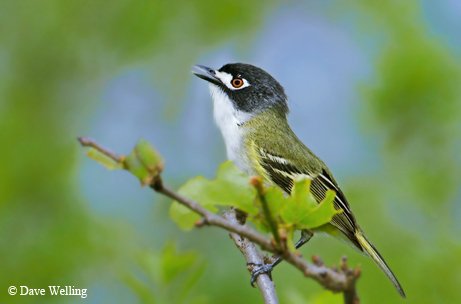
Learn more about the black-capped vireo in "THE BLACK-CAPPED COMEBACK" episode of Better Outside, TPWD's podcast.
Learn more about the black-capped vireo in "THE BLACK-CAPPED COMEBACK" episode of Better Outside, TPWD's podcast.
Black-capped Comeback
The Lone Star State’s most famous vireo was, until recently, its most imperiled. In 1987, the U.S. Fish and Wildlife Service officially listed the black-capped vireo as endangered due to habitat loss and nest parasitism by brown-headed cowbirds. Overgrazing by goats removed “vireo-friendly” vegetation while fire suppression allowed fast-growing species such as eastern red cedar to outcompete the slower-growing hardwoods that the vireo prefers. Meanwhile, land-use changes increased the populations of brown-headed cowbirds, which lay their eggs in vireo nests. When these eggs hatched, the cowbird nestlings outcompeted vireo nestlings, leading to nest failure. The good news is that active land management, including controlled burns and removal of brown-headed cowbirds, has greatly improved black-capped vireo prospects. It was taken off the endangered list in 2018. From a low of about 350 birds in 1987, the population has rebounded to more than 22,000 birds at most recent count. Conservation efforts and monitoring of this songbird superstar continue today.
Speed-dating Vireos
With 14 different species found in Texas, getting to know vireos may seem like a daunting task, especially for a beginning birder. Learning one or two features of some of Texas’ breeding and resident vireos is a good way to start. Here’s what our experts have to say: