At once confiding, reclusive, mellifluous, raucous, resourceful and oft-times baffling, wrens make up for in substance what they lack in glamour. Members of the family Troglodytidae, from the Greek word troglodytes , meaning “cave dwellers,” they have clearly transcended their “cave bird” beginnings and emerged into the light, adding much to our edification and delight.
Compared to the Hollywood glamour of the painted bunting or vermilion flycatcher, wrens may seem like drab, ho-hum little birds. But looks can be deceiving — and wrens are anything but boring. With dummy nests, egg-puncturing forays and a decided taste for polygony (mating with more than one female), wrens — imps of the perverse — afford biologists a wealth of intriguing behavioral questions to ponder. Meistersingers, master builders, not always monogamous but never monotonous, wrens combine a kaleidoscopic mix of “wren world” attributes peculiar to themselves.
The Essential Wren: Characteristics of the Clan So what is a wren? And why is there but one species in most of Europe and Asia when there is such a diverse profusion in the New World, notably Central and South America? Experts believe the wren clan arose in North America and then spread and diversified south. In a second push, wrens ventured north across the prehistoric land bridge to reach the Old World.
With 85 to 90 species worldwide, depending on your taxonomy, wrens are a complex, diverse, incredibly distinctive variation on an avian theme. Wren classification is currently in flux, so be warned: Splits and lumps loom on the horizon for wren species.
Wrens are typically minuscule, and only kinglets, gnatcatchers and some hummingbirds weigh less than the smallest wrens. The cactus wren is our largest, a near-giant compared to the rest, though no bigger than a mockingbird. Wrens are highly active, inordinately curious and ever spritely in their manner. Many species are difficult to see.
Forgoing gaudy colors, wrens dress variously in tones of brown, rufous, gray and buff, often set off in accents of white and black. Males and females look alike. Brown above and pale below, a few sport bars or spots on underpants or barring on the tail. Snappy eyebrow stripes often complete the ensemble. Quintessential little brown jobbies, wrens may present a challenge for the novice. Differentiating one from another — well, the devil’s in the details.
Occupying habitats as varied as piney woods, woodland thickets, reed beds, sedge meadows, cliff faces, canyons or arid scrub, wrens sort themselves out best by habitat. Look for cactus wren in desert thorn-scrub, rock wren along rimrock and talus slopes, canyon wren in steep canyons and shallow caves, marsh wren low in cattail marshes over water and sedge wren in moist meadows. Carolina and Bewick’s wrens may occur in almost any backyard.
More often heard than seen, wrens boast stunningly beautiful songs at a volume well out of proportion to their size. Vocal “wrenditions” from the ethereal to the guttural, both varied and complex, contribute to their exalted status in the world of birdsong. Canyon, Bewick’s, winter, Carolina and house wrens number among some of our finest vocalists, enthralling us with their ebullient nuptial songs.
Wrens have definitely changed with the times, an excellent recipe for success. As human and bird populations increasingly interact, many have expanded their search for the ideal spot to nest. The house, Bewick’s and Carolina wrens, in particular, take full advantage of nest boxes we provide for them. Old boots, baseball caps, vest pockets and even mounted steer skulls prove irresistible to these modern-day opportunists.
Winter Wren: A Puff of Feathers Conquers the World
Greg Lasley | KAC Productions
×
Greg Lasley | KAC Productions
The Old World has but one species of wren — aptly, if not dryly, called “the wren.” Weighing a mere half-ounce, the winter wren pulled off one of the most amazing land grabs in avian history. It successfully founded a new dynasty now limited to the Old World, occupying vast areas of Europe, Asia and northern Africa.
We used to claim Troglodytes troglodytes , the erstwhile winter wren, traditional standard bearer of Old World wrendom. But, based on differences in songs, calls and plumage and lack of hybridization, the species has recently been split into three: Pacific wren, winter wren and Eurasian wren.
Our winter wren is now Troglodytes hiemalis — well named for us in Texas, since it’s very much a bird of winter here. The elusive, silent troglodyte — always a great bird to tick off on a Texas Christmas Bird Count — amazes and confounds us with its stealth, ability to avoid detection and infuriating silence, except for the occasional kimp, kimp call.
Come March, the dusky sylph forsakes the Lone Star State and heads north to breed. There it fills the thickets of the boreal forest with its long, loud, rolling, rhapsodic song. Alas, in Texas we don’t hear its hauntingly beautiful refrains that so gladden the northern forests in spring.
Carolina Wren: Singing 'Dixie,' 'Sweet Caroline'
Greg Lasley | KAC Productions
×
Greg Lasley | KAC Productions
A rufous and ochre charmer with strong affinities for the South, the Carolina wren is a denizen of the forest and dense understory. Residing year-round in the eastern two-thirds of Texas, the state bird of South Carolina inhabits woodlands, swamps and tree-lined suburbs here.
Climbing like a creeper or hanging upside down like a nuthatch, the birds eagerly investigate nooks, crannies, holes and other tight confines in search of insect prey. Basically monogamous, both male and female stalwartly defend the same territory year-round. They will gladly patronize bird feeders or bags of suet laced with nuts and seeds set out for them.
Its signature song is a loud, rich, rolling cheeseburger, cheeseburger, cheeseburger or cher-ae, cher-ae, cher-ae , usually sung in triplets with many variations. An equally diverse number of trills, buzzes and rattles enable pairs to remain in contact. Courting pairs often sing duets, but it is the male that wows us with his extensive repertoire — as many as 40 different versions of its song. Sometimes called the mocking wren, he vaguely mimics songs of other birds, particularly the whistling notes of the tufted titmouse, northern cardinal or Kentucky warbler.
The Carolina wren seeks out tree hollows or other natural cavities to build its nest, but readily adapts to man-made structures — a birdhouse or a hanging flower basket is a favorite spot.
Bewick’s Wren: Say “Buicks”
Rolf Nussbaumer | Rolfnp.com
×
Rolf Nussbaumer | Rolfnp.com
Named for John James Audubon’s friend Thomas Bewick, English artist and wood engraver, the Bewick’s wren is spry, svelte and sonorous. It often flicks its tail from side to side as it moves about in dense, brushy terrain foraging for insects and other small arthropods.
Its sweet, musical song, sounding somewhat like that of a song sparrow, is considered one of the finest of all bird songs. According to experts, the nonsinging female is the silent architect of the male’s song, having played a major role over evolutionary time in perpetuating the genes of the best singers.
The Bewick’s song in Big Bend differs markedly from that of other areas, as song types — and plumage — vary geographically. Comfortably at home near human dwellings, Bewick’s is a familiar backyard bird throughout its range. Like many of their kin, Bewick’s wrens are most adaptable nesters with decidedly eclectic tastes. A can of nails, a baseball cap, almost anything that can be called a cavity will do.
Cactus Wren: Desert Thorn-Bird
Rolf Nussbaumer | Rolfnp.com
×
Rolf Nussbaumer | Rolfnp.com
Texas’ largest and most attractive wren, the boldly marked cactus wren is a denizen of the shrub deserts of the Southwest. Boisterous extroverts, these birds typically fly about in noisy groups making them, for a wren, uncharacteristically easy to see. Forswearing the family’s reputation for stealth, the male sings tirelessly from an exposed perch, breaking the sweltering silence of a sun-baked desert afternoon.
Cactus wrens’ favorite foods include insects, seeds and berries, from which they get most of their dietary moisture, while dispersing seeds of the plants they use the most. They rarely drink or bathe in water, preferring to wriggle about in patches of sand to rid themselves of parasites.
Of all our native wrens, the cactus wren is perhaps the least likely to win a Grammy. Its droning song, a dry rhythmical series of harsh jar-jar-jar notes, seems oddly displeasing to some ears. Yet, in concert with the Cassin’s sparrow, Bell’s vireo and curve-billed thrasher, there’s no mistaking the cactus wren’s contribution to the signature chorale of the desert Southwest.
Master builders, cactus wrens construct a bulky nest in well-armed cholla, prickly pear or cat-claw, aiming for complete impregnability. The well-concealed side entrance follows a long passageway to the football-shaped inner chamber. Prickly on the outside, the nest is amazingly soft inside — amply lined with feathers and fur. The female will select a nearby nest from one of the 10 to 12 additional edifices the male has fashioned for her to raise a second brood. Remaining dummy nests are used year-round for night roosting, by both adults and young of the year.
Canyon Wren: Unchained Rockland Melody
Greg Lasley | KAC Productions
×
Greg Lasley | KAC Productions
One of few terrestrial birds restricted to canyons and rocky outcrops, the well-named canyon wren occupies the western two-thirds of the state. From the lofty Santa Elena Canyon along the Rio Grande to the less imposing limestone outcrops of the Edwards Plateau, canyon wrens hold court year-round. Shy and elusive, they move nimbly and furtively along the shadowy rocks and through dense underbrush.
Short legs and a flattish head and body enable them to squeeze through narrow openings in the rocks, as they probe deep into slit-sized crevices in search of hidden insects. Sharp claws allow them to clamber up and down steep rock faces.
Sometimes difficult to spot, even in open terrain, this rufous wren, white throat and breast agleam, may continue to elude us as it creeps about the jumbled rocks. Now and then a bird will sally forth to seize a flying insect. Or, better yet, a territorial male will alight atop a tall boulder to defend his domain with song.
Throwing back his head, he pours out a clear, rippling vocal cascade that descends through a series of liquid notes te-you te-you te-you tew tew tew tew — a silvery glissando — once heard, never forgotten. Reverberating canyon walls instantly play back his wild and lovely song.
Crevice-nesting canyon wrens construct an open cup nest of wool, hair and feathers on a base of twigs and moss. In some places birds have adopted unoccupied stone buildings, nesting regally within.
Rock Wren: Mysterious Spirit of the Crags
Rolf Nussbaumer | Rolfnp.com
×
Rolf Nussbaumer | Rolfnp.com
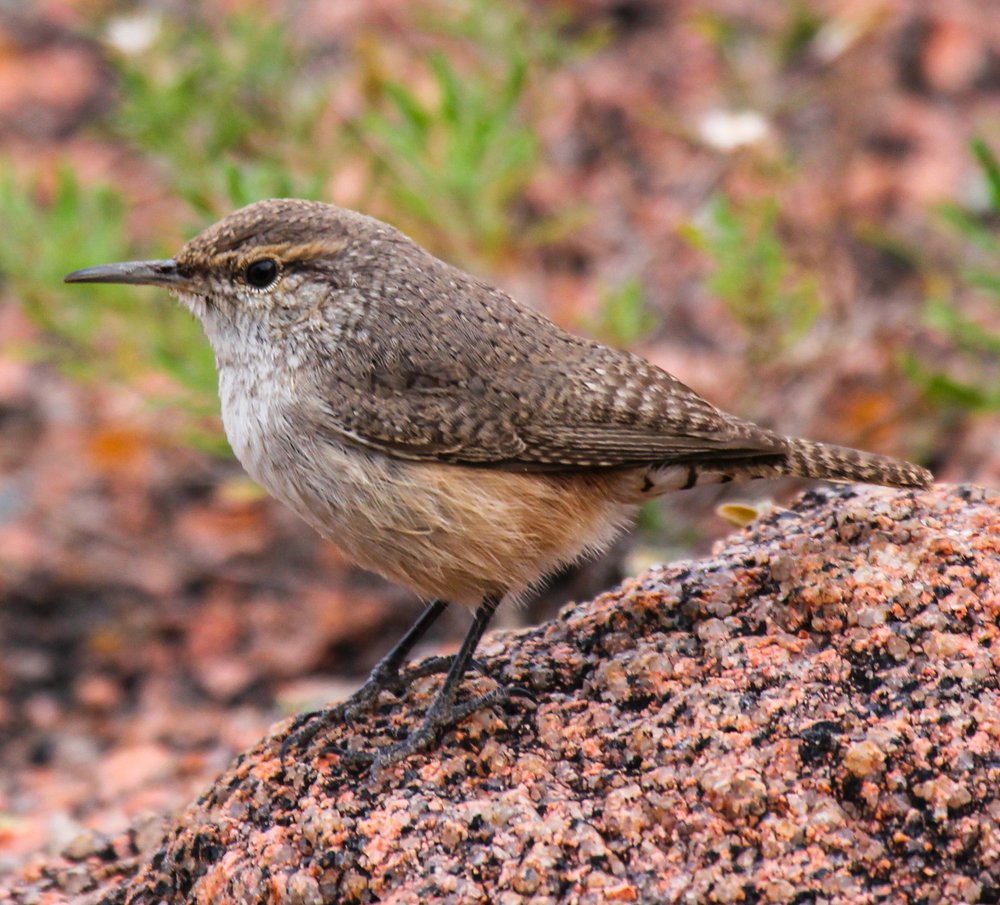
Nimble and hyperactive, the rock wren is a year-round resident of rimrock regions across western Texas. Our palest wren, it seeks out canyons, gullies, stony outcrops, talus slopes and dry gravelly desert washes to make its home. Steep highway cuts and rocky beams are likewise favorite haunts. Although rock and canyon wrens’ habitat choices somewhat overlap, the rock wren is partial to boulders and bare ground, while the canyon wren seeks out shadowy canyons and shallow caves, surrounded by brushy vegetation.
When disturbed, rock wrens may bob up and down mechanically, or crouch down stock-still, disappearing in full view. Their gray-brown upperparts (finely spotted with whitish dots) and subdued eyeliner offer perfect camouflage against the flinty rocks.
Clambering up, down and sideways across the rugged cliffs, rock wrens move jerkily in a series of hops and fluttering flights, leaping up from time to time to nab an airborne insect, in their constant quest for food. Opening their wings, they may parachute down to lower ledges to scour in and out of cracks for deeply hidden fare. Built much like a canyon wren, they deftly extract prey from the narrowest crevices, nimbly negotiating the sheerest rock faces.
The courting male sings an exuberant, metallic song that echoes well across the rimrock walls, tew tew tew tew, cher-wee cher-wee cher-wee . With its mechanical, tinkling mixture of unbirdlike buzzes and trills, the rock wren declares hegemony over his realm. Remarkable singers, males vaunt rich song repertoires of 100 or more song types, many learned from neighboring males.
True to the clan, the rock wren is no exception in its nest-building eccentricities. Seeking out crevices among boulders, old gopher holes or clefts under rock ledges, it constructs its well-concealed cup-like nest within. The rock wren then lays down a path of curious artifacts — pebbles, stones and bone fragments that lead directly to the nest — which rattle each time the bird goes in or out.
Marsh Wren: Songs My Father Taught Me
Kathy Adams Clark | KAC
×
Kathy Adams Clark | KAC
Well-named, marsh wrens favor a wet, marshy habitat replete with dense stands of cattails, bulrushes or spartina, bordering freshwater or saltwater marsh. Shadowy, skulking and hard to see in winter, the phantom lurks out there in the cattails year-round along the coast, staying out of sight till spring. Rustling unobtrusively in the reeds, a small dusky bird flies to the top of a dry cattail seed-head. As he tilts up his jaunty tail, he throws back his head and belts out an exuberant nuptial song. The rattling sound of music is that of the marsh wren.
As song is an essential part of territorial behavior, neighboring males launch highly structured counter-singing tournaments to prove their vocal virtuosity to silent female listeners. Each alternates his signature song with a precise match of his adversaries’ renditions. A young male first learns his vocal repertoire by listening to the songs his father sang. Only later do neighboring males influence the ultimate fabric of his song.
Come spring, if a marsh wren isn’t singing, he’s furiously building a bevy of starter nests. Indefatigable home builders, they fly to and fro, hauling long strips of wet, dead cattail leaves to form the globular nest. Birds punctuate the task with a perpetual stream of charring and buzzing calls.
A master builder, he creates a virtual avian housing development designed for one. A male marsh wren may construct as many as 20 skeleton nests in a season. Known as “cock nests” or “bachelor pads,” they may serve as decoys to confuse predators or as a fallback in the event of nest destruction. Females may choose mates based on their nest-building prowess, preferring the most prolific architects. It’s the female that makes the final choice, as she adds the finishing touches — a soft lining of cattail down — to the nest she deems the best.
The male, not resting on his laurels, continues to work simultaneously on several additional nests, each at a different stage of construction. He clumps them within a few yards of one another. Should any new female pass through the neighborhood, he will naturally be able to offer her one of these surplus models.
Marsh wrens can be voracious nest robbers, destroying other species’ nests, even other marsh wren nests, by piercing or removing eggs or ejecting small nestlings from unattended nests. This makes them exceedingly unpopular with the marshland community. With extreme chutzpah, a marsh wren may even puncture eggs of birds the size of a least bittern. Such havoc in the ’hood is greeted by a flurry of hostile countermeasures by enraged neighbors. Red-winged blackbirds, upon hearing the marsh wren’s song, react directly by sounding raucous vocal alarms and launching relentless aerial attacks against them.
House Wren: Domestic Bliss Was Never Like This
Tim Fitzharris
Early settlers, reminded of the wren they knew in England, dubbed the house wren “Jenny” after the bird they left behind. But there’s nothing girlish about this jaunty, belligerent little mite. Slightly smaller than a sparrow, with a plain brown back, gray throat and chest, it differs from most other Texas wrens by its lack of distinguishing marks. Often cocking its short tail up over its back in full view, it’s still a very plain, brown bird.
House wrens rarely breed in Texas, mostly wintering or passing through during migration. A few nest in the upper Panhandle, and those lucky enough to have watched the soap opera have witnessed the darker face of this unobtrusive bird. Breeding house wrens marry a titillating mix of romance, infidelity, plural wives and broken homes.
Aggressively territorial, the male defends his domain by singing loud and often. He may repeat his complex, bubbly song several times a minute to attract a mate. Courtship likewise entails escorting females to potential starter nests he has built there. He is a habitual, almost obsessive home builder. A male will stuff any likely nesting cavity with twigs, grass and other materials, first to mark his territory and second to provide ample inducements to attract a mate. As he points out the best features of his prospective pads, he punctuates the tour with fervent bouts of song.
As is customary, it is the female that has the final say, and she will line her nest to suit herself. The male may stand guard while she works or he may fly off to start another nest, which may be used for a second brood. Or, should the opportunity arise, he may try to lure a second female and start a new family, or two, or more. In a veritable avian Peyton Place , males may even sneak onto another male’s territory to gain favors from his neighbor’s consort. She oft-times proves amenable as house wren nests invariably contain eggs fertilized by more than one father.
Sedge Wren: Wraith of Moist Meadows
Steve Maslowski | Visuals Unlimited Inc.
×
Steve Maslowski | Visuals Unlimited Inc.
Elusive and mysterious, the elfin sedge wren is best seen in Texas during winter and migration. With shifting populations and a highly secretive nature, this wraith of moist meadows is often difficult to spot. As it creeps about in rank sedge meadows, the golden brown mite remains infuriatingly low and out of sight. Occasionally, though, it will pop up into view.
Perched on a swaying sedge stem, the male pipes his dry staccato chatter, chap chap chap chapper-rrr . By nature nervous, stiff-tailed and alert, a sedge wren rarely allows a lengthy look. When approached, it flutters away feebly, wings flapping like a fledgling. Once out of sight, it drops deftly back into the grass, disappearing like a mouse.
Sedge wrens prefer the higher parts of marshes beyond the cattails and away from water where marsh wrens stake their claim. The best way to distinguish the two is by habitat and song.
Texas: The High Wren District Texas currently boasts nine of the 10 North American species of wrens, more than any other state. From smallest to largest, they are the winter wren, sedge wren, house wren, marsh wren, Carolina wren, Bewick’s wren, rock wren, canyon wren and cactus wren. All but one, the sedge wren, nest in Texas. The house wren is by far the least common breeder, while the sedge wren vies with the winter wren for being the hardest to spot. Devils River State Natural Area and Neal’s Lodge in Concan in early spring are great places to find up to eight species in a single day.