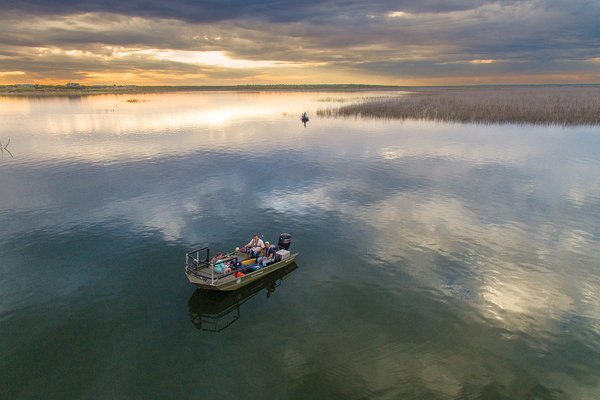
Fishing lakes, like dormant volcanoes and bad boxers, sometimes telegraph their next move, if you know how to read the signs.
O.H. Ivie Reservoir is a case in point. During the 2009–10 Toyota ShareLunker season, a remarkable 11 fish weighing 13 pounds or more from O.H. Ivie were entered into the program, including a new lake record 16.08-pounder that was caught on the last day of the ShareLunker season.
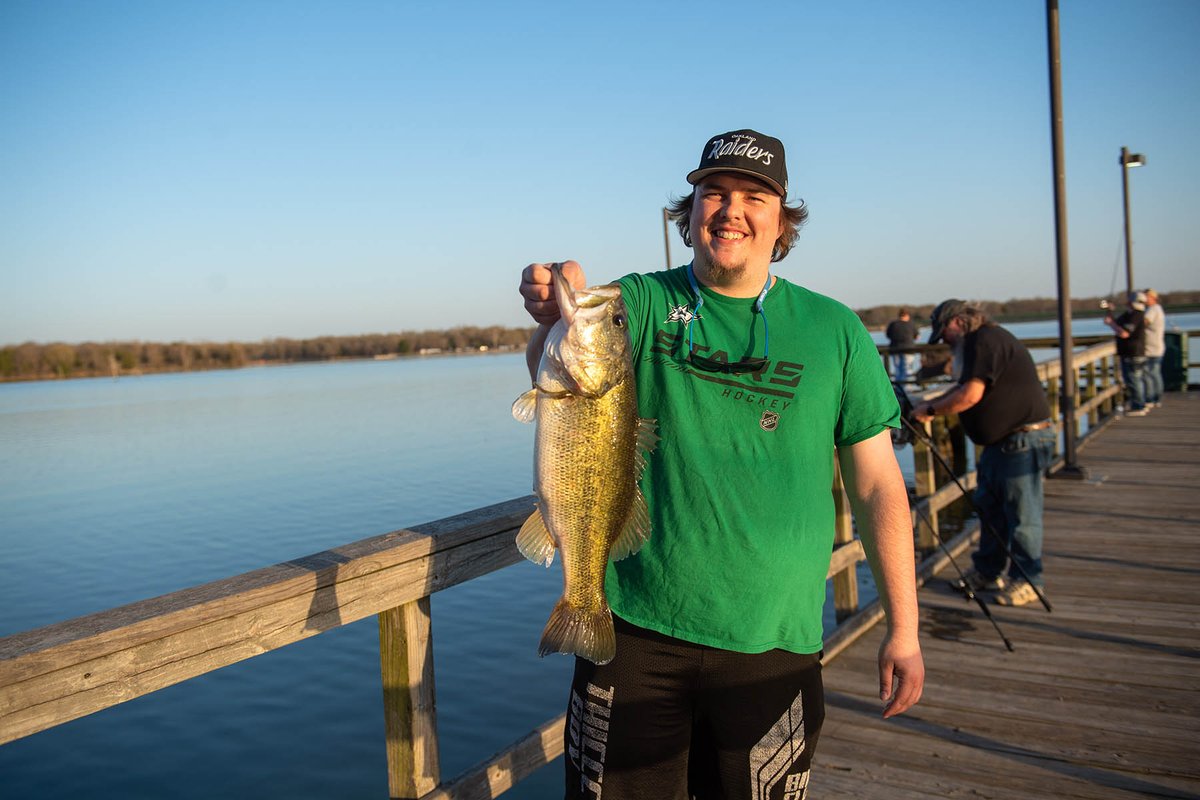
Perhaps the most amazing catch from O.H. Ivie also came on the last day of the season. Wesley Pullig was at the lake to release a ShareLunker he caught in January and decided to do a little fishing as well. He wound up catching the final fish entered into the program last season and joined a very small club of anglers who have caught more than one ShareLunker in a single season.
The program encourages anglers to lend or donate big bass to the Texas Parks and Wildlife Department for spawning purposes.
It might seem that no one could have predicted the explosion of big fish coming from the reservoir east of San Angelo, but there were clues.
“I don’t think we can point to any one factor in particular that resulted in so many ShareLunkers being produced last season,” says TPWD Inland Fisheries biologist Mukhtar Farooqi. “It was probably due to a lot of factors coming together at the right time. Some of these factors we can control, and others we can’t. Our job is to make sure we have the building blocks in place to take advantage of conditions that can lead to trophy fish production. In this part of the state, one of the most important environmental variables is fluctuating water levels, which can have a great effect on the availability of fish habitat and forage.”
It takes a perfect storm to set a lake on fire.
It also takes time, and therein lies another clue to Ivie’s sudden ascension into the ranks of top big bass lakes in Texas.
It’s known that most ShareLunkers are between 8 and 10 years old. It’s also known that some fish grow faster than others. O.H. Ivie was impounded in 1990 and stocked soon after with Florida largemouth bass, which grow bigger than native northern largemouths. “What is commonly known as the ‘new lake phenomenon’ resulted in three ShareLunkers in 2000 and two in 2002,” Farooqi says.
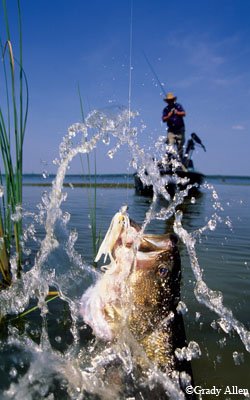
Action shot of an angler catching a bass fish.
Grady Allen
Action shot of an angler catching a bass fish.
Grady Allen
When a lake is producing lots of fish and anglers are not taking many of them home to eat, a lake can become overstocked with small fish, food supplies can fall short, and fish won’t grow as fast or as big, a condition known as stockpiling. This appears to have happened at O.H. Ivie, where the harvesting of bass less than 18 inches was not allowed until a regulation change in 2001.
“The new regulation allows anglers to harvest up to two fish less than 18 inches,” Farooqi explains. “The idea was to increase growth rates of 14- to 18-inch fish by reducing stockpiling through increased harvest.”
Data from the Permian Basin Oilman’s Bass Invitational from 2003 through 2005 showed that the average weight per fish declined. That trend reversed the following year, and the six largest fish recorded each year got heavier. “We hoped the increased size of bass being caught would lead to anglers catching more trophy bass,” Farooqi says.
Did it? In the Toyota ShareLunker season just past, O.H. Ivie’s 11 entries were the second-highest from one lake in the 24-year history of the program.
Only the big-bass mecca of Lake Fork has produced more in a single season.
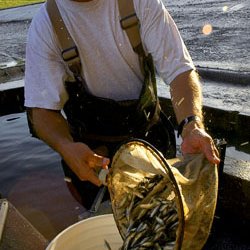
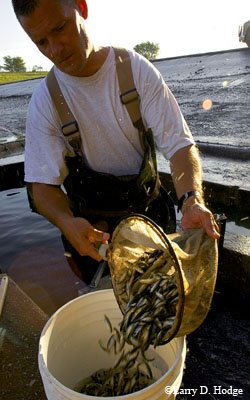
Fingerlings being transferred from net to bucket.
Larry D. Hodge
Fingerlings being transferred from net to bucket.
Larry D. Hodge
Other lakes besides Ivie have also gone on ShareLunker streaks, and a look at the record of catches reveals some tell-tale signs. Ivie’s 2010 run was preceded by ShareLunkers caught in 2000 and 2002, which proved the lake could produce big fish under the right conditions.
Perhaps the closest parallel to Ivie is Lake Alan Henry, near Lubbock. First impounded in 1993, and stocked with pure Florida largemouths, it produced its first two ShareLunkers only seven years later. In 2002 it produced one; in 2004, two more.
Like O.H. Ivie in 2000 and 2002, a pattern was developing — the volcano was rumbling. The first eruption came in 2005, when the lake spit out nine ShareLunkers, a feat it matched the following year before cooling down to two in 2007 and none since.
Some East Texas reservoirs have followed a similar pattern. Sam Rayburn Reservoir had two ShareLunkers in 1993 and again in 1994, three in each of the years 1995 and 1996, and two in 1997. Then came 1998, and the ShareLunker truck made six runs to the lake.
Choke Canyon Reservoir has a similar history: one 13-pound-plus bass in 1990, two in 1993, one in 2005 and two in 2007, followed by six in 2009 and one in 2010. As with O.H. Ivie, fluctuating water levels appear to have played a major role.
Two border lakes with extreme water level fluctuations also send ShareLunkers to Athens on a sporadic basis. Amistad International Reservoir produced its first ShareLunker in 1990, another in 2000, and four during the 2005-2006 ShareLunker season, including the current lake record of 15.68 pounds. Only one entry was produced in 2007 and one in 2008, but 2010 again saw four.
Falcon Reservoir, with water levels that swing even more widely than Amistad’s, has had very uneven ShareLunker production despite having the reputation of being loaded with big bass. However, the stars may be aligning for Falcon. The lake has produced at least one ShareLunker in each of the last three seasons. Water levels are currently high and may be likely to remain that way for a while since Amistad, upstream from Falcon, is above its conservation pool level, the specified level dedicated to water storage. (On a personal note, on a recent trip to our hunting lease on the upper end of Amistad, my wife and I picked firewood out of trees along the shoreline where the wood had lodged four feet off the ground.) Maybe — just maybe — a perfect storm is brewing on the border.
Will O.H. Ivie duplicate Alan Henry’s feat and produce another bumper crop of ShareLunkers during the current season? (The first ShareLunker of the season was caught from O.H. Ivie on Dec. 15, 2010.)
Maybe, maybe not, says Farooqi. “Currently, the lake is about 25 feet low, and fishing has been tough,” he says. “However, I am cautiously optimistic that some ShareLunkers will be produced this season.”
What Farooqi does not mention is that there are probably at least 11 ShareLunkers in O.H. Ivie — the ones that were caught last season were all returned to the lake alive. All ShareLunkers have a passive integrated transponder (a PIT tag) injected, and any that are recaught can be identified. One fish from Alan Henry was caught three years in a row. Fish lightning can strike more than once in the same place.
Anglers hoping to catch a ShareLunker this season have a problem that’s nice to have: deciding where they will have the best chance of landing that fish of a lifetime. Sixty-one public lakes and 21 private ones have now produced ShareLunkers.
The big-bass bonanza is a moveable feast, and while Lake Fork is always a good bet, it pays to keep your ear to the ground and listen for that distant rumble that may warn of an impending eruption of monster bass.