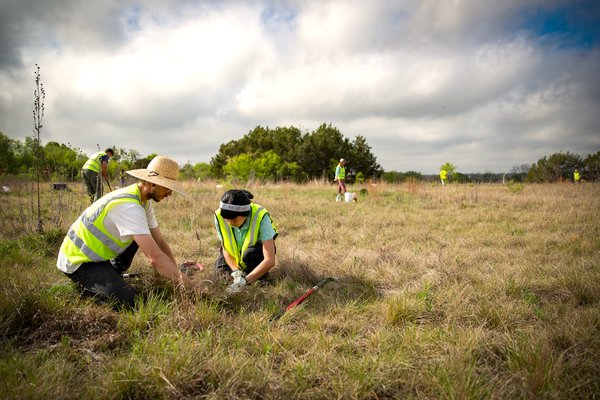
On a sunny November morning, 16 volunteers clad in safety vests and work boots gather at the side of a road near Kingsland, at the western edge of Burnet County. They stand at the entrance to a 45-acre property where, in just a few months, heavy equipment will begin moving dirt for a mixed-use development. First, though, this team of Native Plant Rescue Project volunteers will find, dig and relocate valuable vegetation to save it from the bulldozer’s blade.
The project’s founder and president, Ashley Landry, reminds everyone of the rules: Stay hydrated. Fill in the holes you dig. Take a buddy if you hike to the far side of the property. When you leave, record the number of plants that you took with you.
The only person wearing a button-down shirt instead of work clothes is Gregg Miller, the developer behind the project. He’s stopped by with his son, Kyler Miller, a commercial real estate agent, to thank the rescuers for their work. “We’re glad you’re here, and we’re excited to see what y’all dig up,” he tells them. Then the volunteers hoist their shovels and hike down the old ranch road, past oak thickets and prickly pears bursting with wine-purple tunas, to see what they can find.
Since 2022, the Native Plant Rescue Project has raced to remove vegetation — especially rare and uncommon kinds — from land in the path of development. The volunteer-run nonprofit transfers its finds to school and community gardens that showcase native species and to groups working to restore native landscapes, such as Austin Water’s Wildland Conservation Division. Volunteers can take plants home to their yards, which benefits local pollinators and might inspire neighbors to incorporate more natives into their own landscape.
The project also focuses on seeds, whose distribution can create change on a much larger scale. With harvested seeds, a nursery can propagate far more plants to use in restoration projects or to sell to the public. In the long term, Landry hopes to reshape the Texas plant trade by making it easy for nurseries to offer species that have evolved specifically to thrive in their local region.
“Our whole goal is to save as much of the biodiversity and local genetic material and get it into as many hands as possible for the best future for those plants,” she says.

Volunteers chat with the site developer at a project in Kingsland.

Volunteers chat with the site developer at a project in Kingsland.

Barrel cactus was rescued from the site.

Barrel cactus was rescued from the site.

A volunteer holds up a fringed puccoon.

A volunteer holds up a fringed puccoon.

Breaking ground to dig up species of interest.

Breaking ground to dig up species of interest.
Seeds of a Project
Landry's efforts were born of two frustrations. Through volunteer work as a Texas Master Naturalist, she had discovered an affinity for native plants and wanted to fill her own yard with species she saw while hiking through preserves near her home in Central Texas. But she couldn’t find them at nurseries; aside from about a dozen species, most commercially available plants weren’t local natives. Meanwhile, she watched as fields that might contain these plants were scraped and paved as Austin’s urban footprint expanded. “A lot of the species I was falling in love with just weren’t available,” she says. “We could watch them getting destroyed, but you couldn’t obtain them.”
She started keeping an eye on development news and public records, looking for projects set to break ground within six months. Satellite and street-view imagery helped her determine which sites had not been heavily grazed ranchland and thus were more likely to have uncommon native plants. If a parcel looked promising, she would stop by to assess the landscape from the fenceline. “We are trying to target special sites that have some of the remnant vegetation, that haven’t been disturbed,” she says. “It’s like a treasure hunt. I’m looking for the important things and trying to pull those out before they get destroyed.”
Some native Texas plants, such as prickly pear cactus and coreopsis, are sufficiently abundant that they don’t need the project’s help. Instead, the group prioritizes truly rare plants — those listed among Texas Parks and Wildlife’s Species of Greatest Conservation Need — or plants that are just hard to find. For instance, a recent rescue location had thousands of Texas bluebells, a plant that isn’t endangered or threatened but is still relatively difficult to find.
Landry can’t always tell from the fenceline what plants are present. When the property owner is willing to give the group access, she works to schedule a rescue. She explains to developers that project volunteers are insured, won’t trespass outside of official events and will keep the location confidential if the developer wants privacy.
When Miller was introduced to Landry by a member of the Kingsland Garden Club, it was easy for him to say yes to both the rescue and publicity around the effort. “I thought, ‘What a great idea,’” he says. “I like what they do, because the plants go all kinds of places: botanical gardens, schools, pollinator areas. It’s a neat way to spread plants you won’t normally find at a nursery.”
In September 2025, another group of project volunteers visited the property and collected 300 plants. That day, Landry found a cache of miniature barrel cacti that she’s arranged to convey to the Zilker Botanical Garden’s conservation collection. As Landry tries to find the cacti again, volunteers from the Kingsland Garden Club dig native (though not particularly rare) balsam gourd to pot and tend for their spring plant sale. Staff from the Savanna Project, a Kingsland-based landscaping company that promotes native and water-saving plants, extract several lace cacti for a local coffee shop’s demonstration garden. Because this is a nonprofit rescue operation, they’ll give away any plants they take today. “It’s cool that we’re getting to save a little bit of the natural history around here,” says Roy Dunavant, the company’s natural resource manager.
Austinite Jason Koppe pitches in when someone needs help identifying a plant or carrying materials back to the parking lot. Koppe, the co-leader for this rescue event, started volunteering with the project in early 2025. He helps run the garden at his children’s school, and he and the students have transplanted rescued vegetation there. The work gives him a chance to impart lessons about local ecosystems. “I tell them these are plants that have been here for thousands or more years,” he says. “All of the different insects and birds that live here, or that pass through here, have evolved with these plants, and so they work well together.”


Native plants will get a new home after being saved from development.


Native plants will get a new home after being saved from development.
Native plants will get a new home after being saved from development.
Local Plants, Local Places
That geographic specificity is key to the project’s mission. “One of the reasons our rescued plants and seeds are important is because they’re local ecotypes,” Landry says. The plants at this site are adapted to flourish in the soil and the weather of western Burnet County. That’s why it’s best for them, and the plants grown from their seeds, to find homes in the greater Kingsland area.
When the project provides seeds to nurseries, it includes information about their provenance — where they were harvested. This lets customers in Austin, for example, know that the native plants they’re purchasing originated in Central Texas and are well suited for their region.
The project also works with Austin Water’s Wildland Conservation Division, which manages 49,000 acres of land to conserve endangered species habitat and protect land over the Edwards Aquifer. These properties include Water Quality Protection Lands the city has purchased and is restoring by reintroducing native plants that once thrived there.
Using seeds from the project, environmental scientist Andrew McNeil-Marshall and his colleagues were able to germinate close to a dozen Texas almond (Prunus minutiflora) shrubs, considered a Texas Species of Greatest Conservation Need. “We immediately had a good start on a small population of that plant, which I would expect to find out at some of our managed lands, but that just do not occur out there,” he says. The project later transferred 80 Texas almond plants to Austin Wildlands after finding a large cache of the shrubs at a rescue site. His team had similar germination success with seeds harvested from Silphium albiflorum, or white rosinweed, that the project provided.
As Landry scans the ground, she lets out a cry of recognition: she’s found the barrel cacti again, hiding in the shade of an oak. She reaches for a shovel and a box to carry them back to the car. As word about the project gets out, Landry aims to build its volunteer base across the state so that developers can contact the organization and be connected with responsible, trained rescuers in their area. The project already serves Dallas, Austin, the Hill Country, Houston, New Braunfels and areas south of San Antonio. “We will save the best plants that we can and put them to the best possible use that we can find,” she says.
At the end of the morning, the volunteers will pack up their shovels and transport the plants to their new homes, where they — or their descendants — will live long after the pasture is gone.