The late Tony Amos — best known for his care of injured birds and sea turtles in Port Aransas — had a fondness for laughing gulls. Though often scorned as pesky scavengers, Amos viewed them through the eyes of a naturalist.
“They are the essence of the coastline with their striking coloration, buoyant flight and raucous call that gives our most populous species, the laughing gull, its name,” he wrote in July 2015 for the Port Aransas South Jetty. As Amos aptly noted, the rowdy ha-ha-ha chortles of laughing gulls do sound like birdy laughter. Growing up in Corpus Christi, I knew the joke would be on me if I lingered under any in flight. Luckily, I never got splatted with white goo.
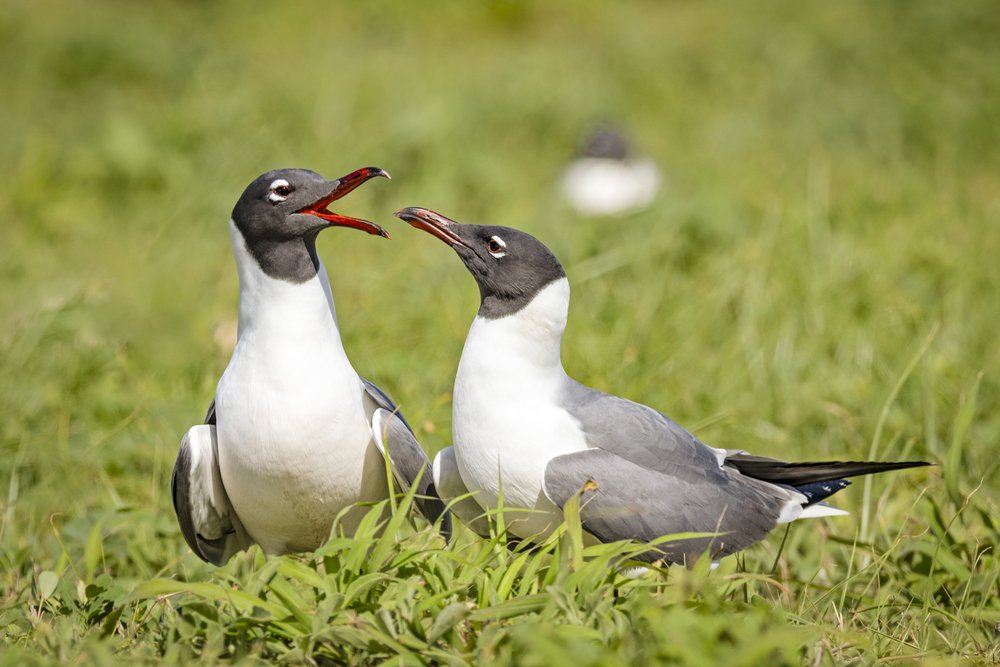
Along the Texas coast, laughing gulls rank as the most abundant of the state’s 11 gull species. Breeding adults have black-hooded heads with slightly hooked red beaks, thin white crescents around their eyes and black-tipped wings when folded. Their close look-alike — the smaller Franklin’s gull — has a straight red bill, thicker eye crescents and white spotted wingtips. In the winter, the black hoods of laughing gulls lighten to white with a gray smudge behind their eyes, and their red beaks darken. By age 3, juveniles molt their drab brown colors and strut breeding plumage.
Mated pairs of laughing gulls may stick together for several seasons. Both parents build their nest on a high place in grass or dense growth on beaches and salt marshes. After scraping out a spot, they line the cup with dry grass stems and other plant materials. Together they incubate and feed their brood of two to four young. Nesting colonies of laughing gulls can number into the thousands.
Because gulls dine on just about anything they can snatch, wildlife experts at the Amos Rehabilitation Keep in Port Aransas urge beachgoers not to feed them. Bread, French fries and other scraps lack the nutrients they need and can harm their overall health. Feeding them teaches the birds to rely on junk food and behave aggressively to get it. What’s more, gulls diving for handouts can get hit by cars.
Sometimes laughing gulls swallow baited hooks or get entangled in fishing lines. (Hooks and lines should always be properly recycled or discarded.)
“Instead of cutting the line, reel in the bird and call a rehab center,” advises Andrew Orgill, ARK’s staff supervisor. “Please don’t pull them up by their necks and bills, especially big birds like pelicans. Volunteers using special drop nets can pull them up safely. At ARK, we’ve had success getting hooks out of beaks and mouths. In some cases, we can X-ray and endoscopically remove hooks from inside their bodies.”
In spite of us humans and other hazards, gulls can live into their 20s. The North American Bird Banding Program Longevity Records lists a laughing gull in Maine that reached nearly 22 years of age.