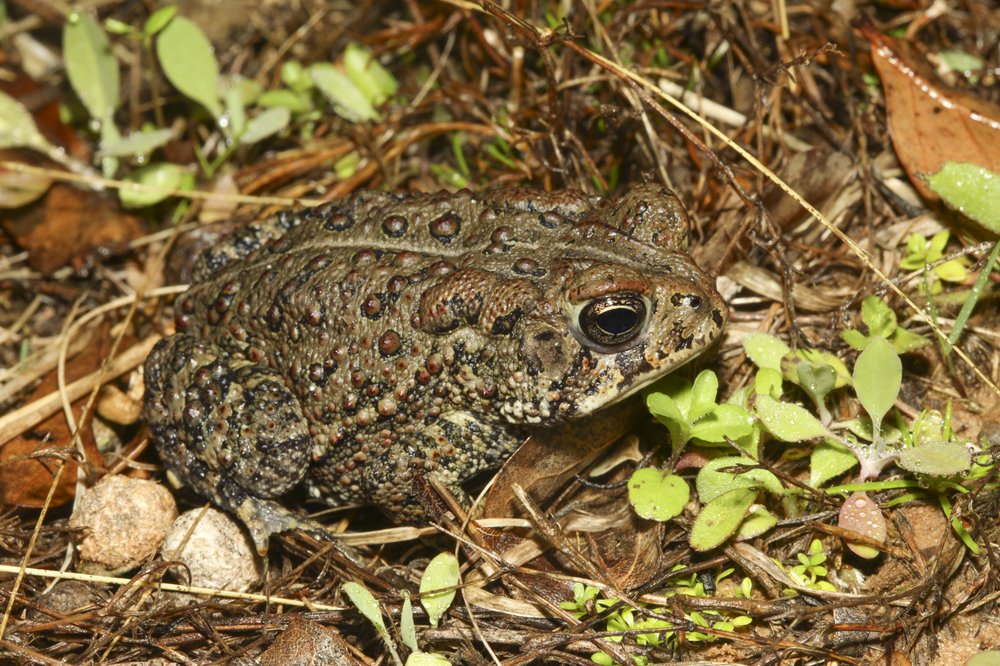
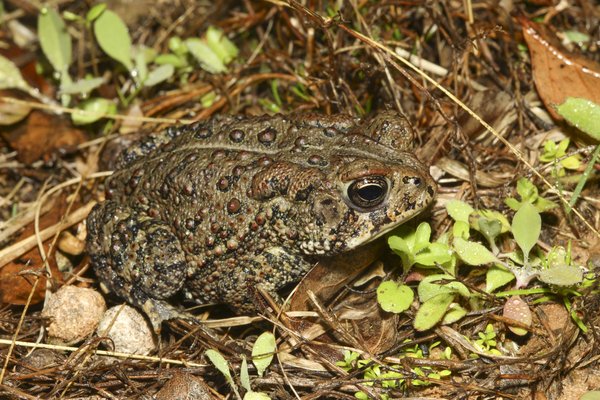
Humid evenings in May at Bastrop State Park are painted with hazy mists and the rosy glow of the setting sun. Listen closely and a sound emerges: the high-pitched, steady thrill-thrill-thrill of a male Houston toad.
About the size of a ping-pong ball, these amphibians are hard to spot among the dense understories of southeastern Texas. But during breeding seasons, their calls echo from shallow ponds, lending the evenings a particular Texas ambience — and giving researchers a short window each year to estimate population numbers.
“The Houston toad is the only toad species that is endemic to Texas,” says Paul Crump, state herpetologist with the Texas Parks and Wildlife Department. “It was one of the first species to be listed as endangered in 1970, and it’s been declining ever since. Its rarity also makes it incredibly difficult to study.”
Urbanization, habitat loss, invasive plant species and environmental changes have reduced Houston toad populations to only a handful of protected areas, including Bastrop State Park, where biologists are testing management strategies and working to reverse decades of decline.
“The work in Bastrop State Park is vital,” says Wade Ryberg, a wildlife ecologist and associate director at Texas A&M University’s Natural Resources Institute. “It’s a kind of living laboratory where we experiment with habitat management, soil treatment and reintroduction strategies.”
These efforts reached a milestone this year when TPWD and collaborators released over 1 million Houston toad eggs across three sites in Bastrop and Milam counties — the largest single-year release to date.
“Houston toads and amphibians in general serve as an indicator species,” says Matt Lammers, Houston Zoo’s Houston toad recovery coordinator. “They let us know when habitats are starting to hit an ecological tipping point.”
Other conservation efforts tend to focus on captive breeding, clearing invasive plants and implementing prescribed burns. Now, researchers are turning their attention underground to a promising factor: soil.
Beneath The Surface
Historically, Houston toads have ranged across many landscapes in southeastern Texas, including coastal prairies, woodland forests and the sandy post oak savannahs of Bastrop County. Those differences have complicated researchers’ understanding of what these tiny amphibians actually require.
“The common denominator seems to be deep, sandy soils,” says Crump. “They heavily define the toad’s chance at survival and are becoming increasingly rare due to habitat loss.”
Most knowledge of the Houston toad’s ecology comes from their first few months of life. As the summer heat moves in, ponds dry up and the toadlets disperse into dense understory. And without a mating call, they become nearly impossible to detect.
“We only know about a small fraction of their life cycle — the two to three months during the breeding season,” says Toby Hibbitts, a herpetology professor at Texas A&M University. “There have been attempts to track the toads with small radio transmitter backpacks, but they usually fall off when they dig underground.”
To better understand their elusive nature, researchers set out to gain a “toad’s-eye” view in Bastrop State Park. Using sensitive probes, they measured soil moisture, temperature and composition near ponds where toads have been previously documented.
“We believe Houston toads like deep, sandy soils because they require a refuge only accessed through burrowing,” says Ryberg. “They can dig several inches down — sometimes as deep as 18 — to escape unfavorable surface conditions. This burrowing behavior allows them to find relief from high temperatures and maintain essential body moisture.”
Inspired by this idea, researchers have begun to explore how unfavorable conditions may affect toads. Reduced canopy shade, along with the spread of nonnative pasture grasses, can leave them more exposed to drying conditions. During periods of extreme heat, soils may also become arid, forcing toads to seek out cooler, deeper layers to retain moisture — an option that isn’t consistently available across habitats.
While these findings are still preliminary, they offer important insight into the Houston toad’s later, more secretive life stages and may shed light on factors of decline.
Other efforts, including research at Sam Houston State University, are studying captive Houston toads alongside two other toad species in Texas. In controlled conditions, they will compare moisture loss, thermal limits and behavioral preferences to better understand what landscapes each species can tolerate and which they prefer.
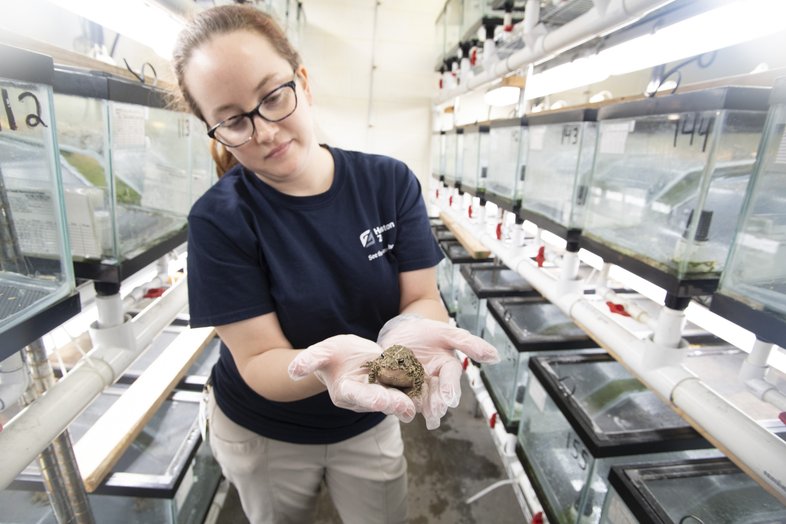
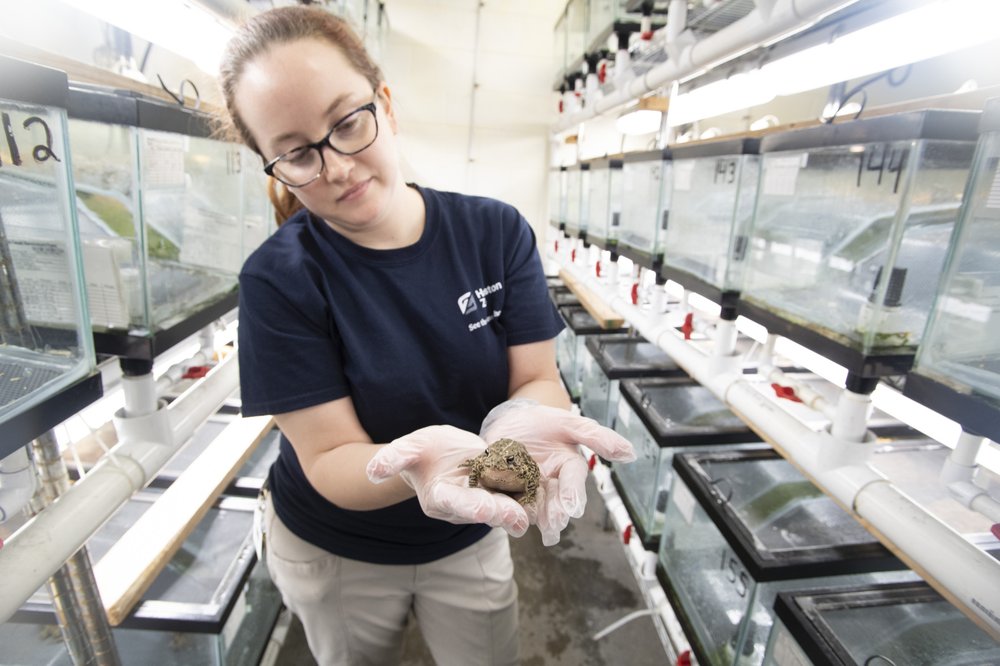
Researchers at the Houston Zoo are studying the toads to understand when habitats hit an ecological tipping point for the species.
Chase Fountain
Researchers at the Houston Zoo are studying the toads to understand when habitats hit an ecological tipping point for the species.
Chase Fountain
Together, these two approaches will build a holistic picture of the Houston toad’s ideal environment by combining lab-controlled findings with field ones. “Right now, there’s a lot we don’t know,” says Crump. “But by looking at these factors and understanding the toad’s behavior, we can begin to piece together suitable conditions that we can use to restore land and support new populations.”
Habitat Restoration
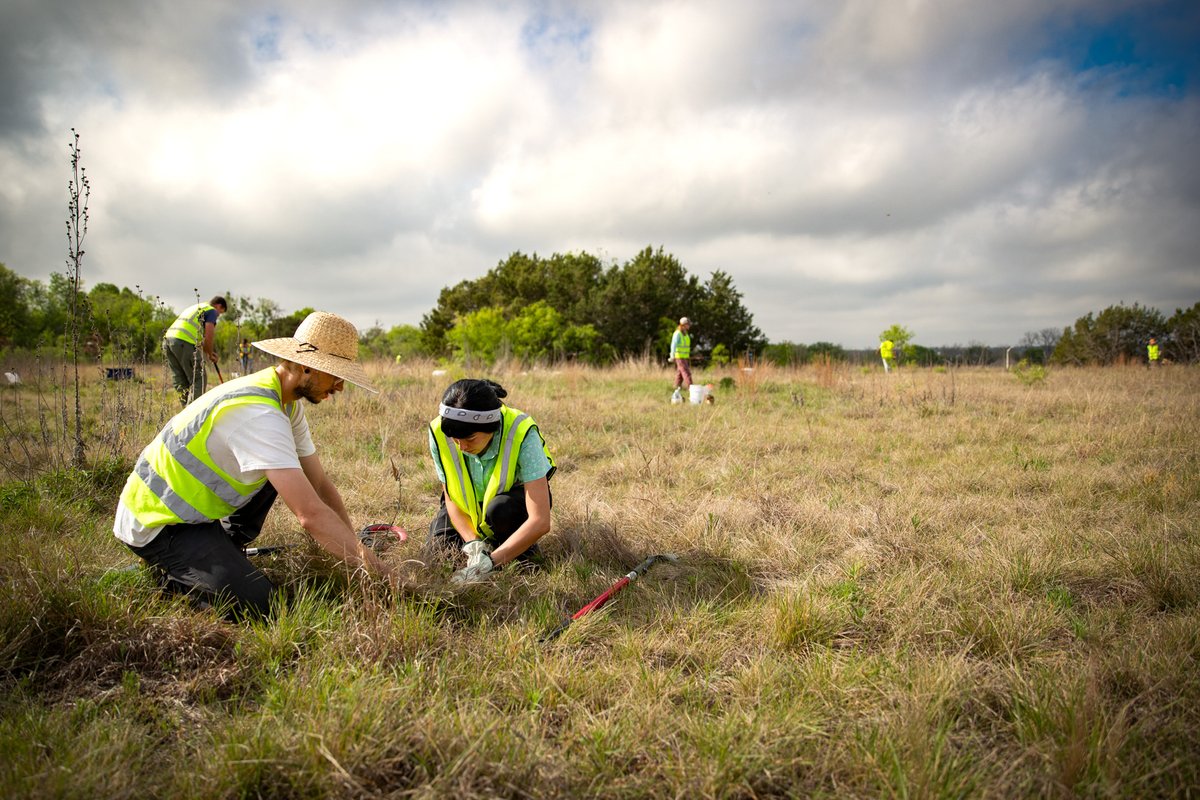
Understanding the toad’s preferred environment is only the beginning. Land management is necessary to restore habitats by improving soil quality and encouraging growth of native vegetation.
“If you’re not focusing on habitat, then you’re losing; we’re losing, you know?” says Crump. “These toads need more suitable landscapes to survive in. We cannot recover the Houston toad just in Bastrop State Park; we need to work with private landowners.”
While the park is well known for its Houston toad habitat, about 90 percent of the toad’s distribution is spread across private lands. Some of those lands used to support post oak savannah landscapes, but have now been overrun with aggressive native brush species like yaupon holly and cedar.
“The ideal situation is to have a series of landowners using similar, controlled management strategies, like prescribed burns, that create corridors to connect these pockets of restored land,” says Hibbitts.
Through the Landowner Incentive Program, TPWD can reduce the financial burden of restoration on private landowners and help them manage their land for the benefit of all native wildlife species, not just toads.
“The Houston toad is not an animal that just needs a pond, a couple of trees and some soil. It needs a vast, connected landscape to persist,” says Crump. “Our goal is to identify those deep, sandy soils and begin to restore them — but restore them in a way that is large and connected enough to sustain populations into the future.”