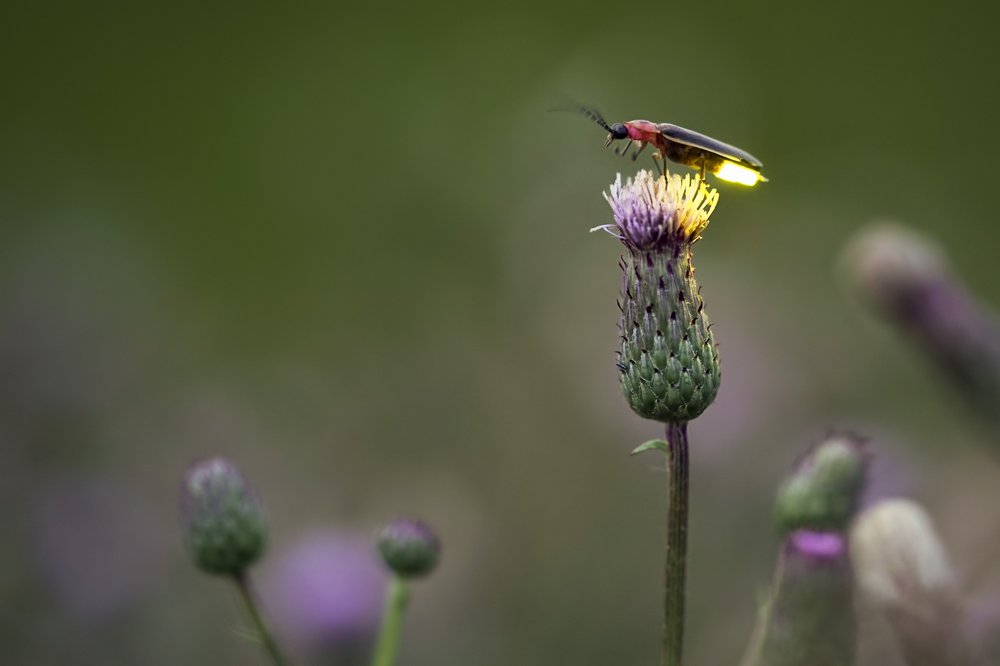
On a warm summer night, you spot a flash among the trees … then another, flickering like tiny floating lanterns. Fireflies! More than 45 species of bioluminescent beetles live across Texas, from the Pineywoods and the Hill Country to the riverbanks of Big Bend.
“What we have here in Texas is really special,” says Ben Pfeiffer, the state’s foremost firefly expert and founder of the nonprofit Firefly Conservation & Research. “We have so many different habitats, and the diversity of species is one of the highest in the United States.” Such remarkable diversity may be rooted in the possibility that Texas was the ancestral home of America’s fireflies — an idea that Pfeiffer’s work with firefly DNA may help prove.
May through early July are the best months to see lightning bugs, often after it rains. You’ll spot them near streams and marshes in the quiet corners of Texas, emerging when it’s dark with their bellies all aglow.
When searching for fireflies, “state parks are a great place to start,” says Pfeiffer, who recommends Guadalupe River State Park and Pedernales Falls State Park. One of Texas’ endemic species, Photinus concisus, drifts along Austin’s Barton Creek Greenbelt; other firefly hotspots include Armand Bayou Nature Center in Southeast Texas and Boerne’s Cibolo Center for Conservation. But you don’t have to travel far to find the magic.
“City parks can be good places, too,” he says, especially those with creeks or ponds.
Pfeiffer encourages children to catch and release fireflies — with care. “It’s the only way they’re going to learn about fireflies and why we need to protect them.” Gently gather them in a net, then place them in a jar with holes in the lid and some apple slices or a moist coffee filter inside. Release them within the hour. Most importantly, let females go immediately (they’ll have fewer, smaller light organs on their undersides and generally have larger bodies and smaller eyes).
No matter where they appear, lightning bugs are very sensitive to light pollution, drainage and pesticides. They need pockets of moisture and leaf litter to survive — and they also need our help. “Fireflies are in decline in areas due to habitat loss from suburban and commercial development,” says Pfeiffer, “but there are worthwhile things you can do to protect them.”
Start by going easy with the rake. Leave leaf litter in gardens and along tree lines, or keep a wild patch on one side of your yard. You can also build a firefly habitat: Stack logs in a pyramid shape or in Lincoln Log-style layers. As the wood decays, it will create a dark, humid habitat where female fireflies can lay their eggs and immature fireflies can develop. You can verify your space on Firefly.org as a Certified Firefly Habitat, the firefly equivalent of a monarch butterfly waystation.
“People see fireflies as children, and then it just stays with them their entire life,” says Pfeiffer. “It’s a great charismatic insect that people really love.” Because even in a land as big as Texas, some of Mother Nature’s most awe-inspiring wonders come in tiny, twinkling packages.