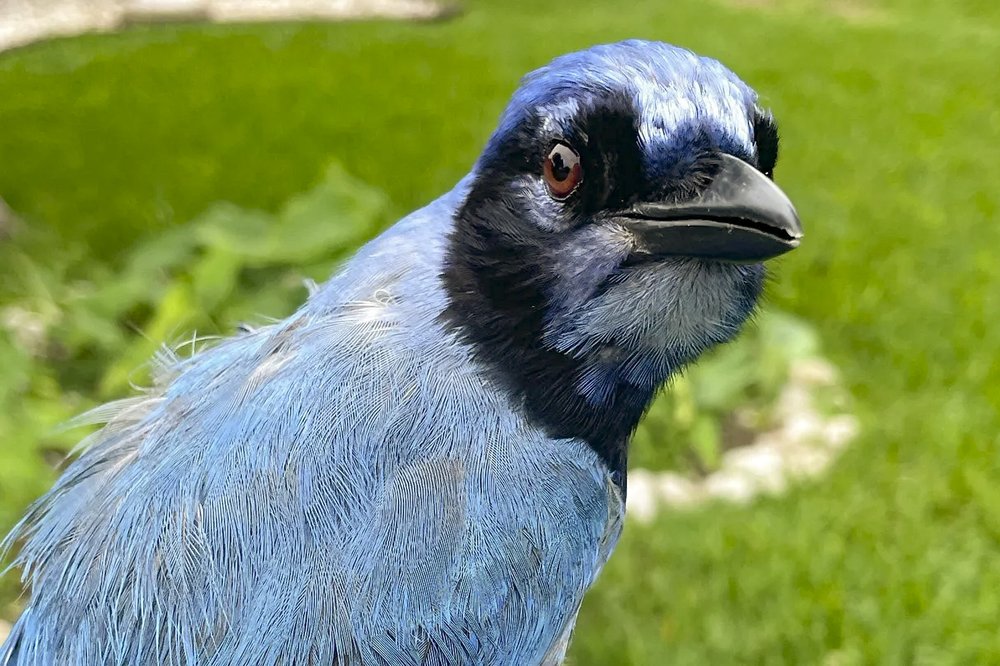
On a scorching sunny day in June of 2023, Brian Stokes, a Ph.D. candidate studying green jays at the University of Texas, stumbled upon a peculiar image of a blurry blue bird while monitoring social media for his own research. Fascinated, he quickly contacted the landowner to inquire about the bird’s location in the northeast suburbs of San Antonio.
“It took two days of field work to capture it,” remembers Stokes. “We watched for a while, and it was interesting to see its behavior. It commonly interacted with blue jays in the area, but we could tell this one was different.”
To his knowledge, this is the first record of a hybridization between a female green jay, or Cyanocorax yncas, and a male blue jay, or Cyanocitta cristata. Each parent species genetically diverged 7 million years ago, making this new bird — dubbed a “grue jay” — a special case.
“To me, this discovery was stunning,” says Timothy Keitt, an ornithologist and Stokes’ faculty advisor at the University of Texas. “There have been very low sightings of both species in the area, and they haven’t crossed paths until recently.”
Tania Homayoun, an ornithologist with the Texas Parks and Wildlife Department, says it’s actually quite difficult to distinguish true hybrids by morphology, or appearance, alone.
Variations in plumage (color), song type and behavior often overlap among genuses. As a result, researchers frequently group similar-looking individuals into preexisting categories — especially when there is a limited sample size.
“In science, it’s typical for a slate, or group, of species to be reclassified every few years by ‘lumping’ several new species together based on the latest evidence,” says Homayoun. “Other times, a species is split into multiple, more precise groups as our understanding of their genealogy improves.”
In the case of the grue jay, Stokes and Keitt wanted to confirm it wasn’t merely a one-off, lookalike blue jay. Their 2025 paper confirmed its hybrid status through DNA analysis of blood samples collected during capture.
Interestingly, the bird’s genetic diversity is remarkably high and similar to what scientists see in lab-made hybrids. In fact, it closely resembles a preserved, taxidermied 1970 lab specimen from the Fort Worth Museum of Science and History, the offspring of an intentionally crossbred green jay and blue jay. This distinction suggests the grue jay isn’t just a fluke, but potentially the start of a new and unexpected evolutionary path.
Shifting Ranges
Bird-watchers catching sight of both parent species in Texas have noticed an uptick in their co-occurrence since the early 2000s, with preliminary data records from survey sites like eBird suggesting that both are increasingly sharing the same spaces.
Historically, blue jays ranged across the eastern United States and extended just past the Houston area. Green jays, from the 1950s and onward, have been documented all across Central America, with their range ending just over the South Texas border. Now, green jays have moved north while blue jays have moved west, converging in the San Antonio area.
But what pushed these two distant species to combine? Stokes says the answer is anthropogenic-induced change.
“Shifts in weather patterns and urbanization have played a huge role in moving these ranges,” explains Stokes. “Land use modification and supplemental feeding from bird feeders, ranches and game feeders have definitely aided their expansion.”
Using climate data and weather modeling, Stokes and Keitt also predict that the overlap between the new ranges covers about 5,200 square kilometers — roughly the size of Rhode Island. This area is expected to grow as more birds are forced to compete, or copulate, with one another for suitable habitat.
“Clearly, 7 million years of evolution was not enough to stop this example of pairing,” says Homayoun. “I think the real question is, what’s this going to look like as more habitat is displaced in the future? It’ll be interesting to see what takes over if hybrids do become more commonplace. It’s a constantly changing body of knowledge that’s out there.”
Citizen Science
While the grue jay might not be the flashiest bird on the block, its hybridization highlights how much there is to learn about avian diversity in a rapidly changing world, especially in less-studied suburban areas.
Typical fieldwork is concentrated in more accessible or wild habitats, meaning there could be many hybrids waiting to be discovered in overlooked communities.
“If people are wondering, does my eBird checklist matter? Even if it’s a common bird? I would say absolutely yes,” says Homayoun. “Your participation gives scientists a really robust view of how birds across the continent are faring. It can help identify patterns of species abundance, movement and population trends on a large scale — something a small group of scientists just can’t do.”
The same landowner and backyard birder who initially posted the grue jay on social media has reported seeing the hybrid again roughly two years after its capture, during the summer of 2025. Since then, however, the individual has remained elusive.
“In a world where environmental change is accelerating, the unlikely becomes more probable, and hybrids are no longer just rare exceptions but signs of ecological shifts,” says Keitt. “There could be more grue jays out there that we have yet to see. But for sure, going forward, the unexpected should now be the expected.”
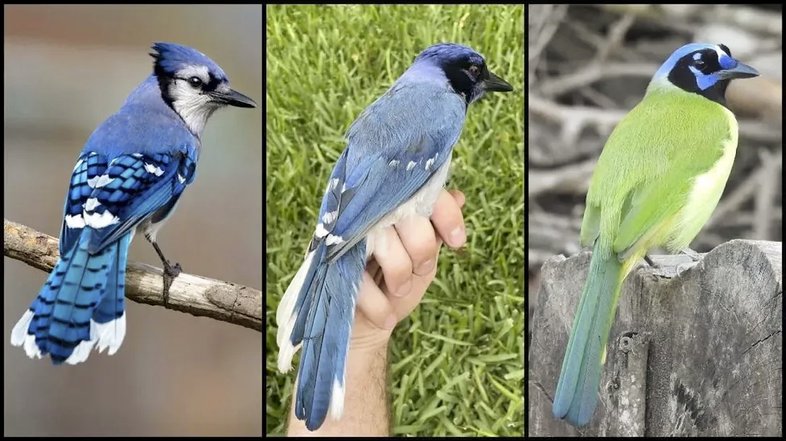
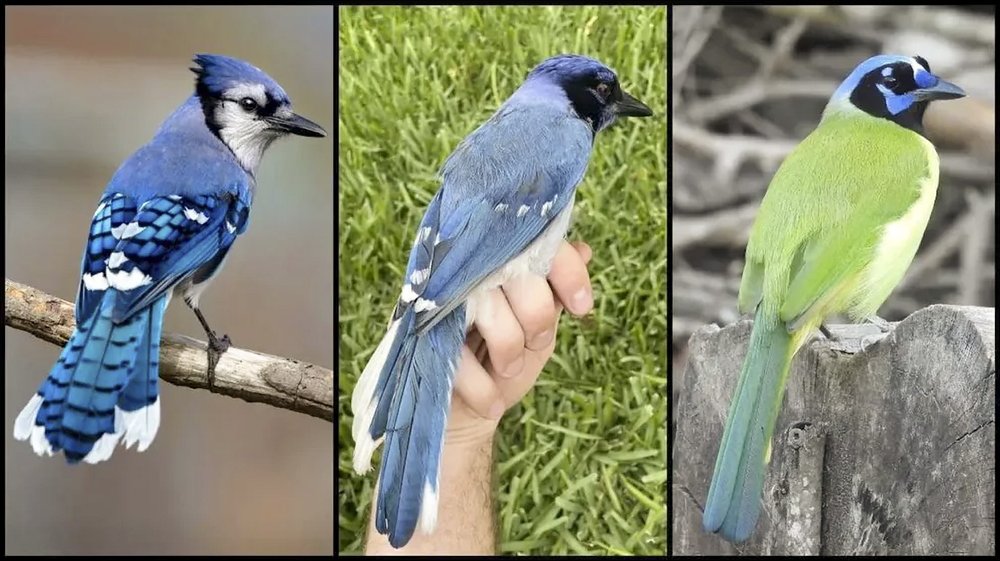
Blue jay, grue jay and green jay
Blue jay, grue jay and green jay