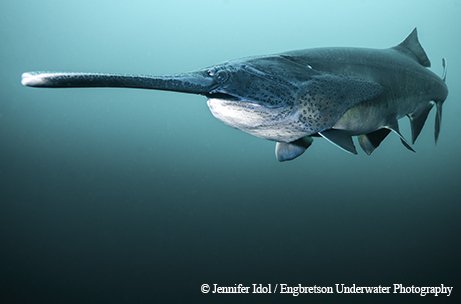
In the murky waters of East Texas, a prehistoric giant swims open-mouthed, scooping up tiny plants and animals. Paddlefish (Polyodon spathula) can weigh up to 200 pounds and grow over seven feet long from eating only plankton. The underside of their protruding namesake “paddle” is covered in taste buds, allowing them to sample the water and find the highest concentrations of their food, which they filter from the water using comb-like structures called gill rakers.
These fascinating freshwater fish were once common in East Texas rivers, but overharvest and habitat fragmentation — especially rivers being dammed to create reservoirs — led their populations to dwindle. In the 1970s, Texas listed the species as state-threatened.
Two decades later, in the 1990s, the Texas Parks and Wildlife Department began stocking the fish in East Texas water bodies, including the Sabine and Sulphur rivers and Big Cypress Bayou, hoping to restore these ancient giants to their historic homes.
“The summary takeaway for the success [of the project] in the 1990s was that it wasn’t that successful,” says Quintin Dean, assistant biologist for the TPWD Inland Fisheries Marshall District. “They stocked all these fish, but then when biologists went back out to try to see if they could catch any, to see if they had continued to survive … they didn’t catch any fish.”
But then, more than 25 years after those 1990s stockings, something changed. Dean and fellow fisheries biologists go out on the Sabine every spring to survey for white bass. In recent survey years, “We have been seeing more and more adult paddlefish in the Sabine River,” says Dean. “And when I say adult paddlefish, these are anywhere from 30 to 80 pounds — these are like a meter-and-a-half-long fish. So, they’re very large and very healthy paddlefish.”
That means the Sabine is providing conditions for paddlefish to thrive. “Depending on how fertile your system is, you might have really skinny fish,” Dean says. “That’s what we tend to have in the Big Cypress; it seems like a lot of fish we catch out of there are pretty thin, whereas the Sabine fish, all the ones we’re catching are incredibly fat. They’re very healthy and most likely gravid [egg-laden] females.”
Paddlefish are a relatively long-lived species and can survive up to 30 years.
“When we started seeing all these fish on the Sabine River, we got excited,” Dean says. “We were like, ‘Well, if this is the case on the Sabine River, there’s six other rivers that we’ve done this [1990s stocking] on.’”
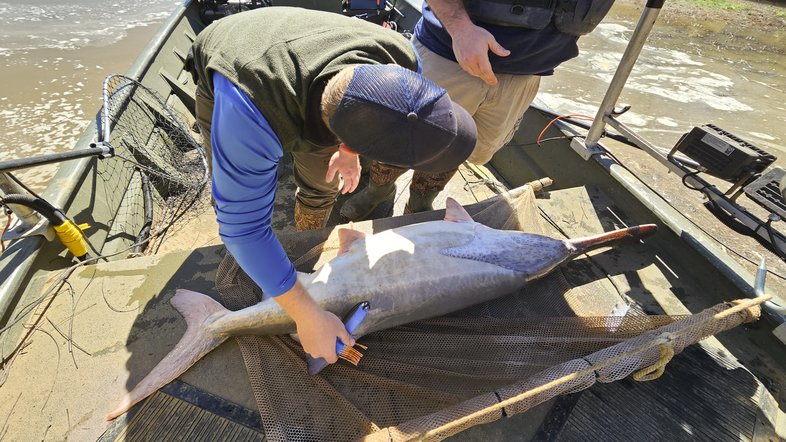
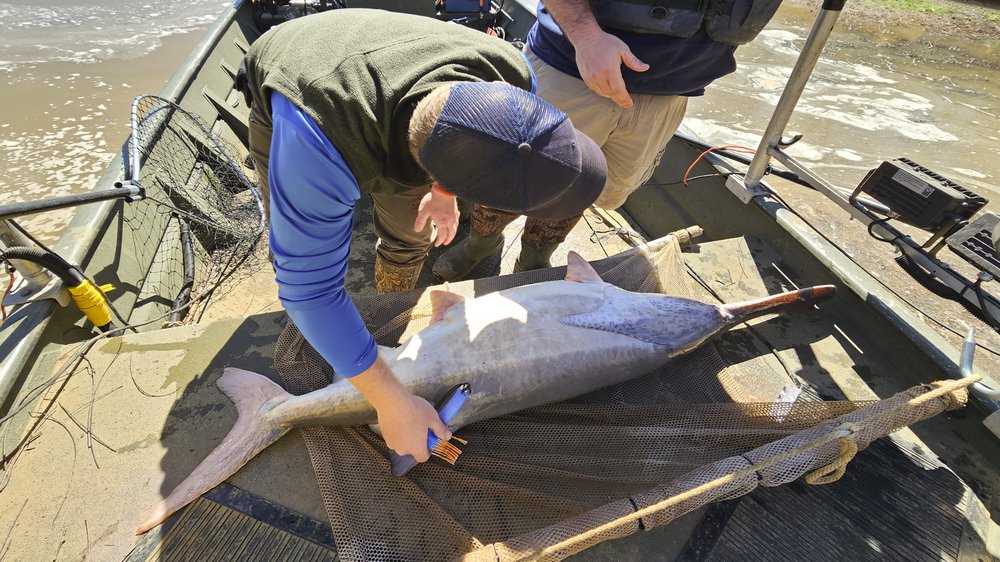
Biologists tag a Sabine River paddlefish.
Biologists tag a Sabine River paddlefish.
A Paddlefish Reassessment
Over the past year, Dean and fellow biologists have kicked off a project to assess paddlefish populations in East Texas waterways. After the perceived “failure” of the 1990s project, paddlefish monitoring all but stopped on the majority of the water bodies in which they were stocked.
The new project will restart paddlefish monitoring in the Sabine, and extend to other rivers in the coming years. “My hope is to start documenting these fish — measure them, tag them, and see if we’re locating [the same fish] year after year. But it’s also to try to drum up interest and support in some of these other river systems,” Dean says.
Paddlefish surveying is not without difficulties. Biologists conduct the surveys via electrofishing, in which a shock is sent through the water, temporarily stunning fish and causing them to float to the surface where they can be collected and counted. However, electrofishing is limited to around 20 feet of water depth, and when paddlefish aren’t looking for gravel bars to spawn, they prefer the cooler, deeper waters of reservoirs such as Toledo Bend.
Dean and colleagues are currently investigating the best methods of surveying for these fish. 2026 was the first year of the new project, and despite low water levels in the Sabine, the team was able to catch and tag 32 fish.
The end goal of Dean’s paddlefish project is to assess paddlefish populations and whether fisheries conservation and management actions can lead to conditions supporting eventual removal from the state-threatened list.
“I think it would be really cool for Texas Parks and Wildlife to [be able to] say, ‘Hey, look, we had this paddlefish that we considered threatened, and now we were able to take it off the list because 40 years ago, biologists had the foresight to start doing something, and now we can fish for it.’ It’s a really cool, long-term story.”
There’s a long road before that can happen. “In order to [delist the species], we have to unbiasedly assess the population — just because I want them to be able to support a fishery doesn’t mean that they should if the numbers aren’t there,” says Dean.
After determining the best ways to collect paddlefish and the best ways to assess their populations, biologists hope to turn their attention to other questions. If biologists find that a robust adult paddlefish population exists, they will next aim to document any reproduction that’s occurring. The biologists know the fish are surviving, but are they reproducing? A reproducing paddlefish population would be a huge milestone of success in the reintroduction effort.
Paddlefish reproduction remains a challenge. The fish need large amounts of flowing water in order to reproduce. The construction of dams along Texas rivers has interrupted water flow and disconnected paddlefish from their historic spawning grounds. That’s a factor that’s not likely to change anytime soon.
In the meantime, TPWD continues to support paddlefish in other ways. The agency continues to partner with the U.S. Fish and Wildlife Service, Oklahoma’s Tishomingo National Fish Hatchery, the Caddo Lake Institute and others to stock paddlefish in Big Cypress Bayou, where agreements are in place to release water from the adjacent dam at Lake O’ the Pines in a way that more closely mimics natural conditions with higher and lower flow periods throughout the year.
Paddlefish are the oldest surviving animal species on our continent — these prehistoric fish predate the dinosaurs and have been swimming around in what is now North America for around 300 million years. Thanks to the hard work of fisheries biologists, they will hopefully be swimming open-mouthed in our rivers for millions more.