Wander the paths at Blair Woods Nature Preserve in East Austin, and along the way you’ll meet Rusty the lizard. He’s the grinning caricature of a Texas spiny lizard that appears on interpretive signs posted in the sanctuary. Rusty honors a lengthy research project on his species that was conducted at the site.
From August 1951 to October 1956, W. Frank Blair — then a zoologist at the University of Texas at Austin — gathered data with help from his wife, Fern, and some graduate students. Altogether, they caught and marked more than 3,000 Texas spiny lizards, then called rusty lizards, on the couple’s 10 homestead acres, now managed by Travis Audubon as Blair Woods. In 1960 Blair published his findings in a 185-page book titled The Rusty Lizard: A Population Study.
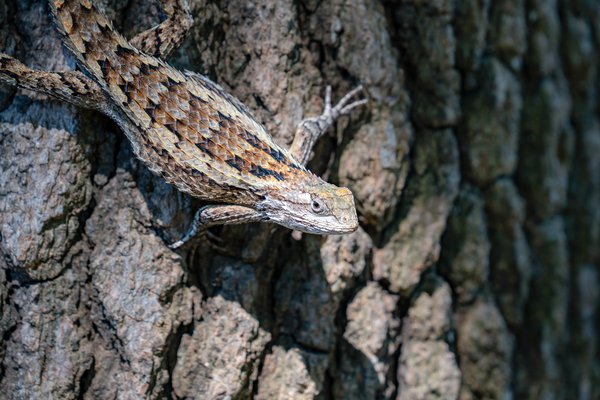
Of the state’s 10 spiny lizard species, the Texas spiny lizard is the most commonly seen. If you’re sharp-eyed enough, that is. Measuring up to 11 inches long from snout to tail, these long-toed lizards disappear against the bark of oaks, mesquites and other trees, where they live. That Houdini-esque ability to mimic bark stems from their grayish or brownish markings and rough scales. While some lizards like skinks are smooth scaled, spiny lizards have keeled scales, meaning each one has a centered ridge like a boat’s keel.
When threatened, spiny lizards use a few escape tactics. If danger approaches, they may freeze and flatten against the bark. Or they may scuttle to the tree’s other side and continue circling out of sight until they’ve reached safety higher in the tree. If attacked, their tail, which doubles as a balancing aid, can break off. While the wiggling tail distracts the predator, a lizard makes his getaway and later regenerates a new but shorter tail.
At times, spiny lizards may venture to the ground to hunt. When prowling for a meal, a lizard hangs low on a tree base and scans his surroundings for an insect to pounce on. Their favorites include grasshoppers, beetles and insect larvae. In his book, Blair reported the rare instance of one swallowing a rough green snake. But lizards aren’t the top of the food chain; another singular sighting was a jumping spider that killed a small lizard. In the wild, spiny lizards of all ages (and sometimes their eggs) may fall prey to snakes, armadillos, skunks and feral cats. That said, most lizards live two to five years.
Size-wise, mature females are larger than males, which have light blue stripes on the sides of their bellies. Mating occurs on the ground from mid-March into summer. Females dig their nests in bare ground and can deposit 20 or more eggs. After covering their nests back up with dirt, females go about their business and may lay more clutches. Little ones hatch around two months later. In the winter, spiny lizards hibernate under leaf litter or in the soil.
During warm months, Texas spiny lizards can be seen every day at the Blair Woods Nature Preserve. Sometimes they scuttle past the remains of a large metal trap.
Like Rusty the lizard, it stands in tribute to Blair and his assistants who used it, among other methods, to wrangle many a Texas spiny lizard.