Red is the first color to disappear in the water column.
Colors are just wavelengths reflected by an object, and water filters out those wavelengths, starting with the lowest-energy ones. As the water gets deeper, red is the first to go, followed by orange and yellow; blue and violet are last. The colors disappear underwater in the same order as they appear in the color spectrum.
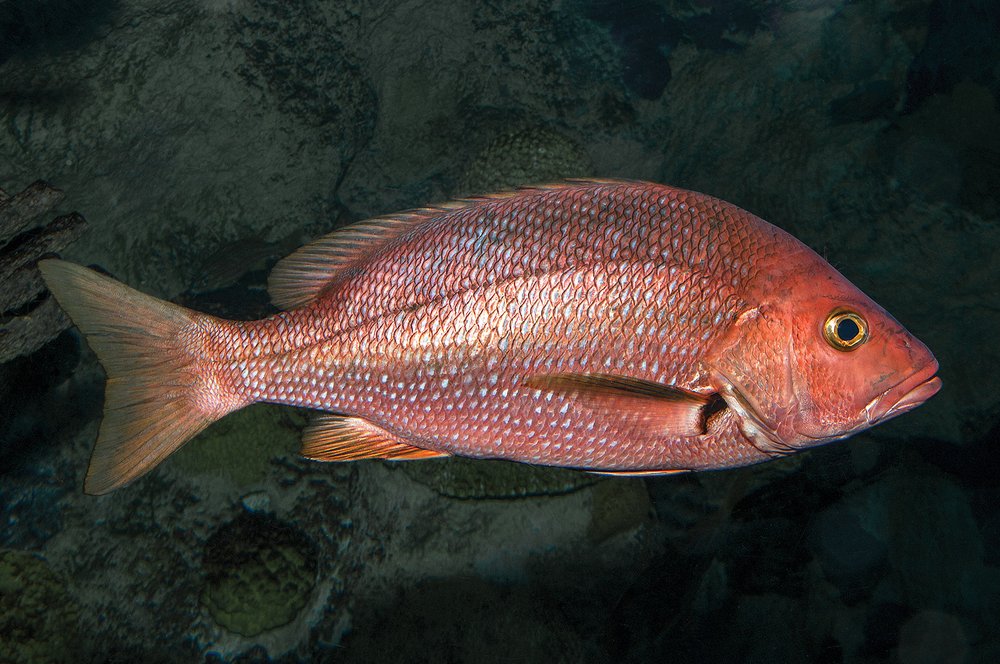
Red snapper are some of the reddest fish around.
“Everything about them is red,” says Mark Fisher, Coastal Fisheries science director for the Texas Parks and Wildlife Department. “They’ve got red eyes, they’ve got red bodies, they’ve got red fins. That’s what distinguishes them from some of the other snapper species.”
Underwater, though, the brightly colored red snapper looks like merely a gray snapper.
“It’s good camouflage,” Fisher says.
Red snapper generally live in deeper water, 30 to 200 feet, often around structure. They find food and cover in places such as ridges, reefs, shipwrecks and oil rigs. Or Coke cans.
“There’d be a little Coke can sitting in about 150 feet of water,” Fisher says of underwater ROV (remotely operated vehicle) surveys he’s conducted. “And there’s a snapper sitting right on top of it.”
Red snapper have a long triangular face, a spiny dorsal fin and short, sharp teeth. The presence of several canine teeth is a definitive characteristic of all snappers.
They feed on crab, squid, shrimp and small fish, and in turn are eaten by sharks, jacks and, of course, humans.
They are one of the most sought-after offshore fish.
“Red snapper tastes really good,” Fisher says. “It has a pretty mild taste, and it’s kind of flaky. It will accept a lot of sauces and spices. It’s very versatile.”
What’s Fisher’s favorite way to prepare it? Veracruz-style, with tomato sauce, olives and capers.
Red snapper can grow to 30 pounds or more, and a typical size is 5 to 10 pounds. They can live up to 60 years. Fisher says the average red snapper caught off the Texas coast last year was 22 inches long and 6 pounds.
In 2021, the Great Red Snapper Count led by the Harte Research Institute for Gulf of Mexico Studies at Texas A&M University–Corpus Christi found a surprising number of red snapper in the Gulf. The count estimated a population of more than 118 million, compared with previous estimates of 36 million. A large percentage of red snapper occurred over “uncharacterized bottom habitat” (other habitat categories were “artificial reefs” and “natural hard bottom”).